I Pitched This Wedding Venue a Redesign. Then Their Google Visibility Took Off.
They didn't hire me. So I went backwards through their old website, rankings and backlinks to figure out what changed, and what actually seems to have moved the needle.
A few months ago, I was doing what I apparently do for fun now: looking at wedding venue websites.
I came across a beautiful historic barn venue outside a major Midwestern city. The property had character, and the business was well established. The website? Not so much.
It wasn't terrible. It was just doing that thing I keep seeing with wedding venues, where the actual property is far more distinctive than the website makes it look. So I emailed them, told them I thought the site was underselling what they'd built, and asked whether they were considering a redesign.
They never replied. Fair enough.
Then, several months later, during another round of wedding venue research, I stumbled across them again. Except this time the website was different. They'd redesigned it.
Well. Apparently I'd correctly identified the problem. I was just a few months too late to sell them the solution.
And then I did something I probably shouldn't have if I wanted to get anything else done that day: I checked their search visibility.
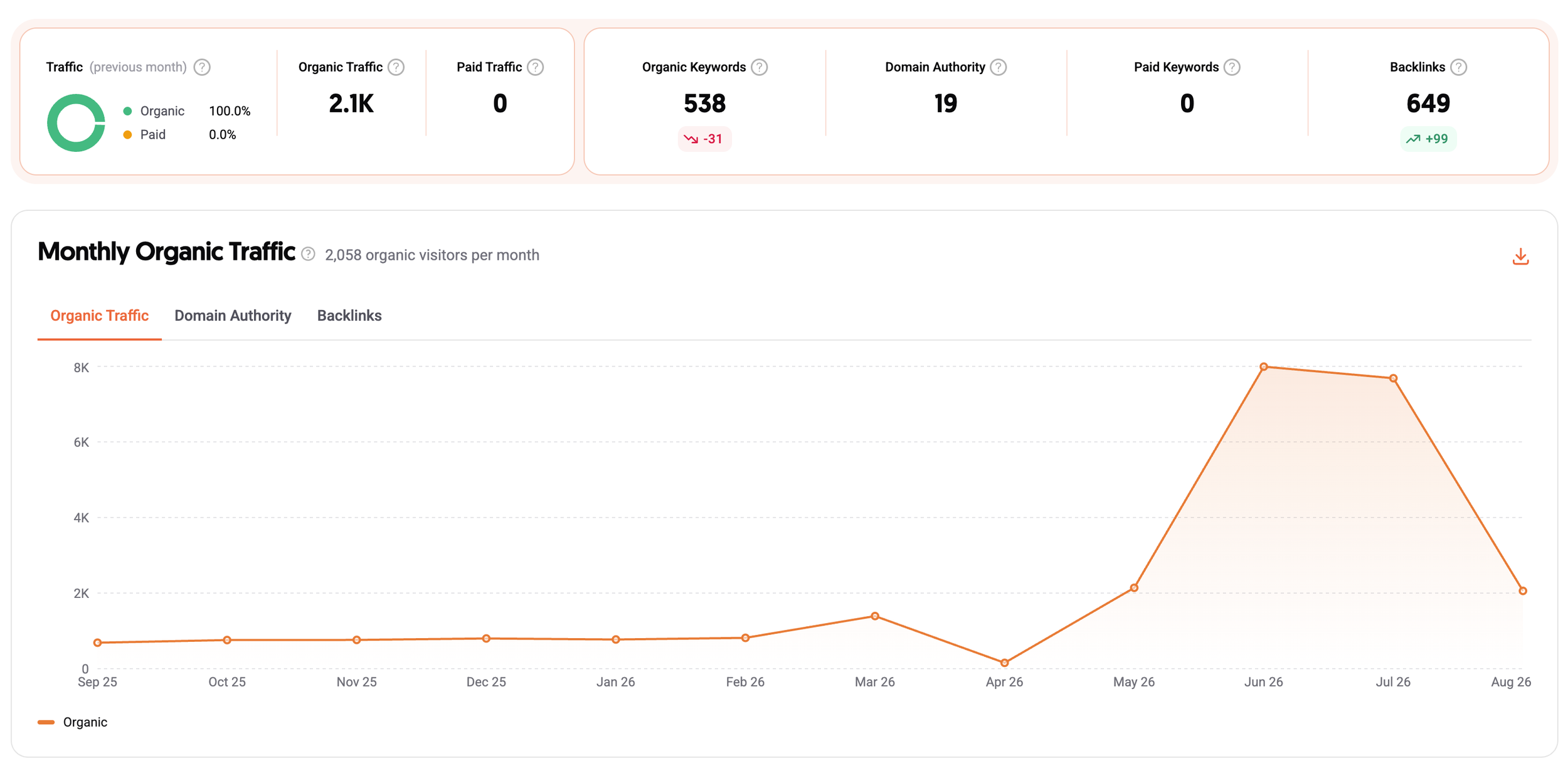
This was the graph that sent me down the rabbit hole. Ubersuggest shows a dramatic increase in estimated organic visibility after the redesign — although, as we’ll see, the absolute traffic numbers need a very large grain of salt.
A quick note about that number: Ubersuggest is estimating traffic based on keyword rankings, search volume and expected click-through rates — it isn't seeing the venue's actual analytics. In this case, a few high-volume, heavily localized searches appear to inflate the estimate substantially. Other SEO datasets (DataForSEO) put the absolute number much lower. So I’m using this graph as evidence of a change in search visibility, not evidence that the website actually received 8,000 organic visits that month.
Oh.
Now I had questions, because according to the SEO data I was looking at, something fairly dramatic had happened around the same time as the redesign. Estimated organic visibility went from roughly 60–70 in April and May to more than 3,000 by September.
That's the kind of graph that makes it very tempting to write “Wedding venue redesign increases organic traffic 4,000%!!!” and stick seventeen fire emojis next to it.
Unfortunately, that's not how evidence works. So instead, I went backwards.
First: this is not my client
I want to be very clear about this before we go any further. I didn't design this website. I don't know the venue owners or the agency that redesigned it, and I have no access to their Google Search Console, Google Analytics, Google Business Profile Insights, inquiry data or bookings.
Everything in this case study comes from publicly available information: archived versions of the website, search results, backlinks, ranking history and third-party SEO data. So when I talk about "traffic" or "visibility," I mean modeled estimates, not their actual analytics.
I'm also deliberately not naming the venue. I'm interested in understanding what changed and what other independent wedding venues can learn from it, not in turning somebody else's business into an unsolicited public audit. Some identifying details and numbers have been generalized or rounded for that reason.
With that out of the way: what the hell happened?
The timing was suspiciously good
I reconstructed the website's history using archived captures, sitemap modification dates and other public evidence. The old site was still archived in mid-April. Around 18 of the new site's core pages appear to have been modified on April 23–24, and the new website shows up in the archive by May 16.
So the most defensible launch window is roughly late April to mid-May 2026, probably toward the earlier end.
Now compare that with estimated organic visibility:
| Month | Modeled Organic Visibility |
|---|---|
| April | 62 |
| May | 71 |
| June | 463 |
| July | 1,793 |
| August | 2,901 |
| September | 3,062 |
Interesting. Also not proof that the redesign caused it, because correlation is still correlation even when the graph is really, really satisfying.
And once I started digging, the story got a lot messier. Which is exactly why it's useful.
I reconstructed the old website
The old site had about 20 pages. The new one has about 18 core pages plus a handful of blog posts. So this wasn't a case of "They published 150 SEO pages and Google rewarded them." They didn't. The website barely got bigger.
What changed far more was what those pages were actually doing, and nowhere is that more obvious than on the homepage.
Before the redesign
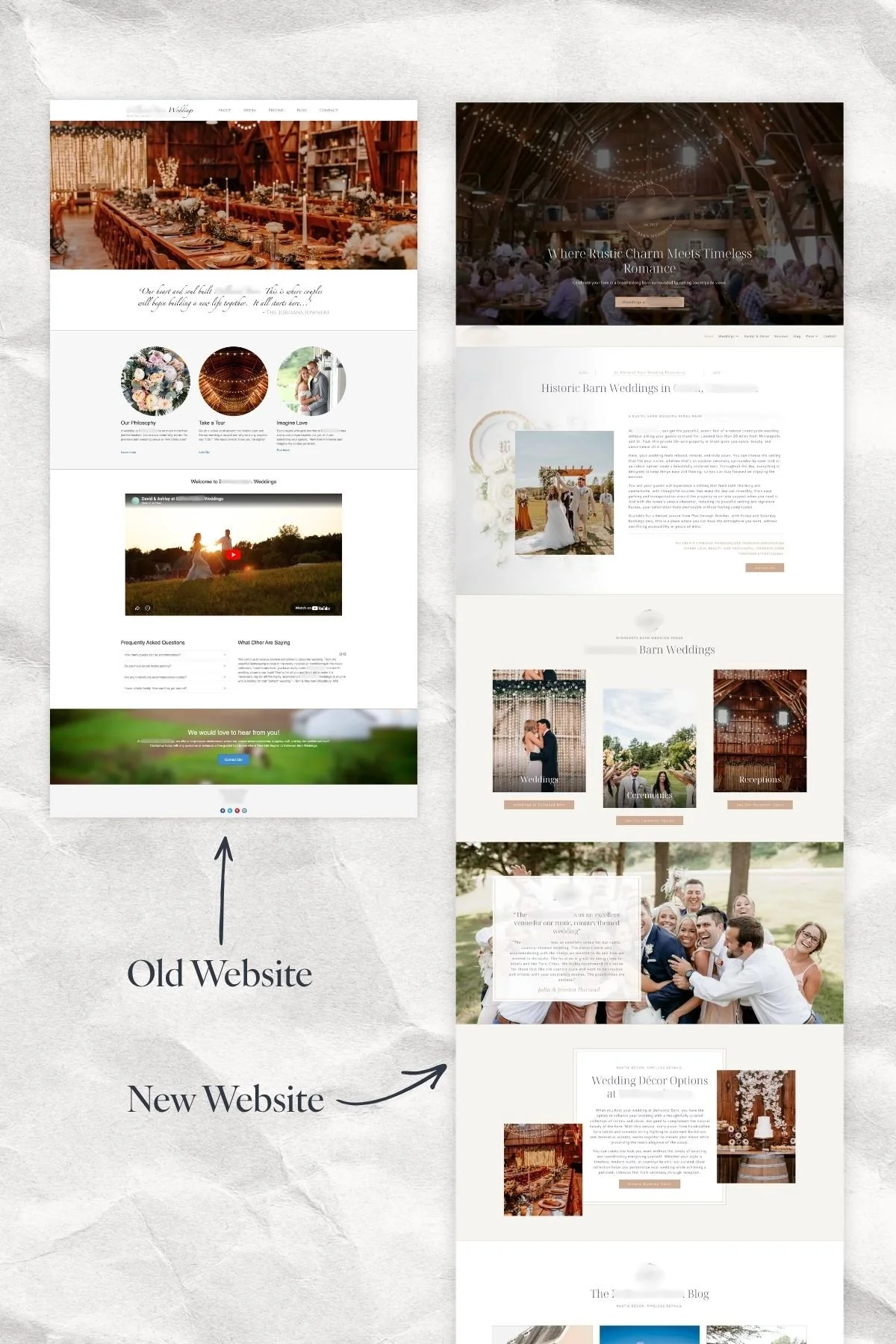
The old homepage had no H1, no meta description, no detectable schema, and a title of about 125 characters trying to target multiple cities at once. I still had a screencapture of the old homepage in my archive.
There was useful information on the website, but the homepage itself wasn't giving Google a particularly clean answer to a very basic question: what is this business, and where is it?
After the redesign
The new homepage title essentially says Barn Wedding Venue in [State]. The H1 essentially says Historic Barn Weddings in [Town], [State].
There's a proper meta description now, a lot more homepage copy, geographic references throughout the page, nearby cities mentioned by name, and clearer internal linking. Suddenly the page speaks the same language people use when they search for this type of venue. Not metaphorically. Literally.
And here's where it gets funny. The visible marketing headline still says something along the lines of “Where Rustic Charm Meets Timeless Romance,” which could be dropped onto roughly 94% of barn wedding venue websites without anyone noticing.
From a positioning perspective, I wouldn't choose it. But underneath all that timeless rustic romance, the website is sending Google a remarkably clear message:
BARN.
WEDDING VENUE.
[STATE].
HERE. 😂
You don’t have to turn your homepage into an SEO ransom note
One reason I find this case so interesting is that venue owners are often handed a false choice: write beautiful, emotional copy for humans, or write hideous keyword-stuffed copy for Google.
You don't actually have to choose.
Your hero can say something emotional. Your brand can have a personality. Your photography can do a huge amount of the selling. But somewhere on that page, preferably fairly early, Google (and the couple who has never heard of you) still needs to understand what you are, where you are, and who it's for.
This redesign got a lot more explicit about the first two. And the rankings that followed are very interesting.
Almost all of the search visibility belongs to ONE page
This was probably my favorite finding. The SEO tool found 675 ranking keywords for the domain, and 656 of them point to the homepage. Roughly 99.5% of the site's modeled organic visibility is attributed to.
The new ceremony pages, reception pages, getting-ready pages, decor pages, FAQs and blog posts? Together, they account for about 0.5%.
That doesn't make those pages useless. They can answer buyer questions, support the sales process, add internal context and make the site a lot more useful. They're just not what's driving the current organic visibility, at least according to the data I could access.
So the lesson here isn't “create lots of pages.” It's closer to “make your most important page extremely clear about what you're selling.” Much less exciting than a 97-step content strategy, and apparently much closer to what happened.
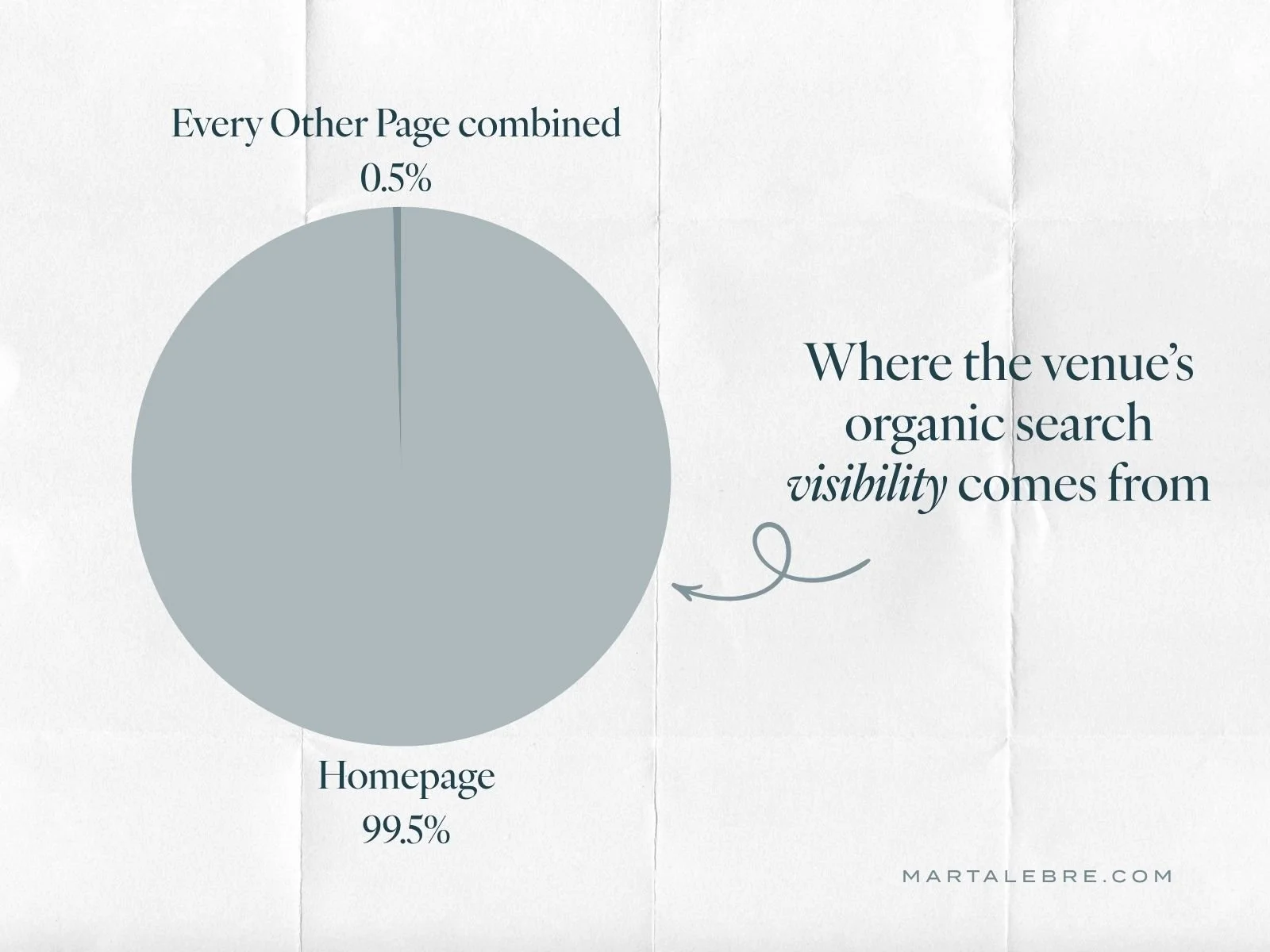
Almost all of the venue’s estimated organic visibility belongs to a single page: the homepage.
The location signals are everywhere
This is another thing the new website does aggressively well. The homepage doesn't lean on the brand name and hope Google figures out the rest. It establishes the venue category, the state, the actual location and the nearby cities. The site architecture reinforces what kind of business this is, and the Google Business Profile adds another very strong local signal.
When I checked one generic barn-venue query from the nearest big city location, the venue showed up #1 in the Local Pack and around #6 organically. For another state-specific barn venue search, it came in around #2 organically in the live local check.
| Search | Before Redesign | After Redesign / Current |
|---|---|---|
| barn wedding venues [STATE] | #17 | #2 locally |
| wedding barn | #95 | Low 20s* |
| barn wedding venues | #72 | #6 locally |
| wedding barn locations | #27 | #6 locally + #1 Local Pack |
| wedding venues near me | Not in Top 100 | Tool says #40 — not reproduced locally |
*This ranking had already improved substantially before the new website launched. Location-specific terms have been anonymized. Historical positions come from third-party ranking data; current local positions were manually checked from the venue’s metro area.
The pattern matters more than any individual position. The venue is now showing up prominently for exactly the kinds of non-branded, location-specific searches that can introduce it to couples who weren’t already looking for it by name.
This isn't a business trying to rank everywhere. Google simply has a lot of evidence connecting this business → this category → this place, which is exactly what a local wedding venue needs.
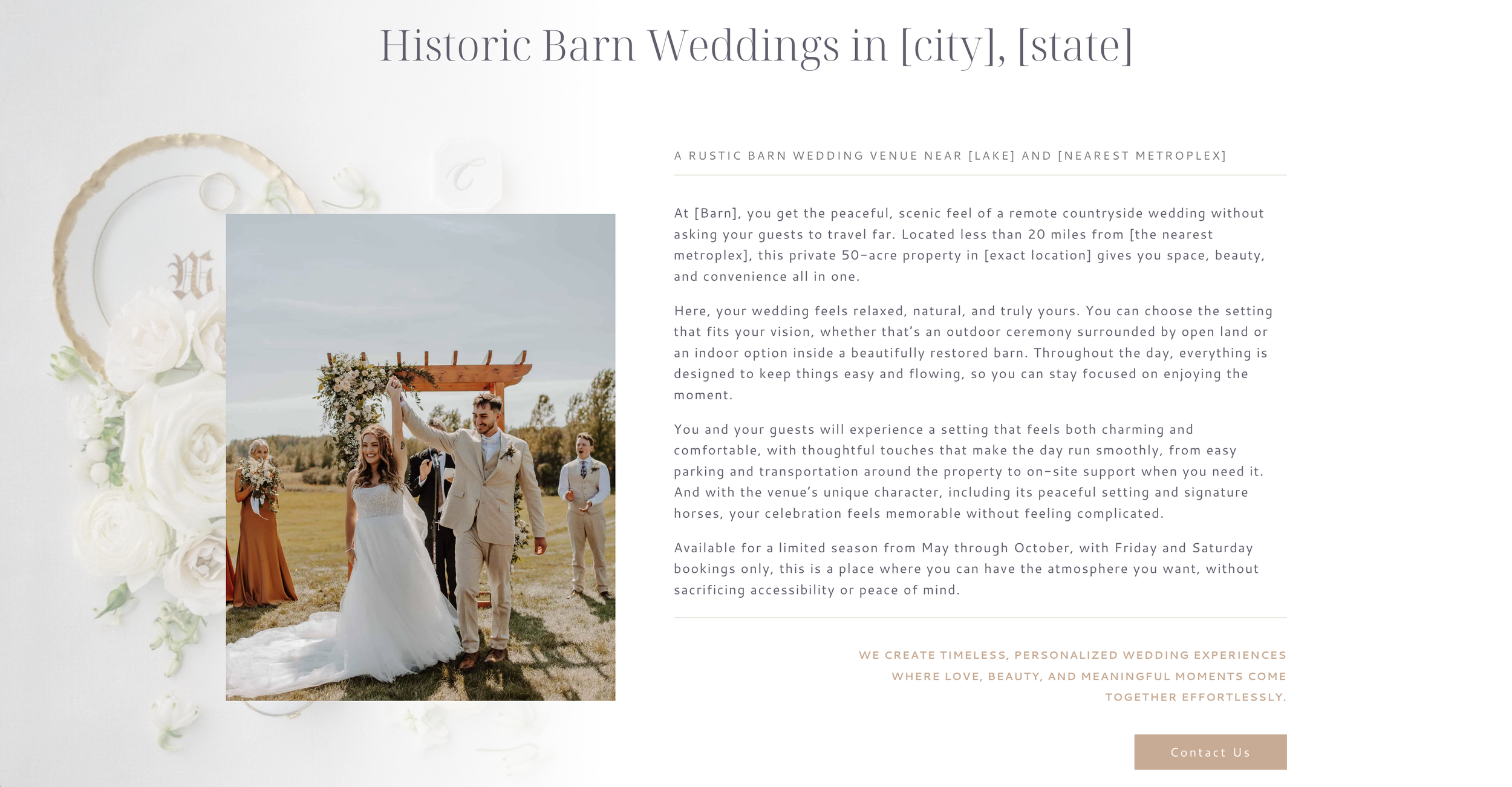
Nothing revolutionary here. Just a very clear answer to three important questions: What is this? What does it offer? Where is it?
But the redesign didn’t create this business from nothing
This is where I started trying to disprove my own theory. If I wanted a nice clean wedding venue SEO story, I could stop here: old website bad, new website optimized, rankings explode, everybody goes home.
Except this venue already had a lot going for it. The domain is around 12 years old, and the brand appears to have been operating for about 15. It had roughly 100 legitimate referring domains, including photographers, wedding directories, vendors and editorial mentions. Its Google Business Profile has nearly 200 reviews. And it had years of local relevance and brand history behind it.
In other words, the redesign didn't manufacture authority. A lot of that authority already existed. I think that may be one of the most important lessons in this whole case study: the new website may simply have given Google a much clearer page to apply the authority the business had already built.
That's very different from “Put ‘Best Wedding Venue in [state]” in your H1 and enjoy your 4,000% traffic increase.” Please don't do that.
The reviews were already there, too
I wondered whether a big jump in Google reviews could explain the growth. Nope. The venue did have a significant review surge, but much earlier: 37 reviews came in during July–September 2025, roughly eight months before the redesign. Review velocity actually slowed after launch.
Could those reviews have contributed to the venue's overall local strength? Absolutely. Can I tie them directly to the post-redesign jump? No, the timing doesn't support it.
Backlinks don’t explain it either
Another obvious suspect: maybe someone launched the new site and ran a huge link-building campaign at the same time. But referring domains stayed roughly flat, around 100–115, from 2022 through mid-2026. Even more interesting, the total number of backlinks actually fell during part of the visibility surge.
There was eventually a big influx of very questionable links, but it arrived in August and September, after the growth had already started. So no, I'm not giving the spammy backlinks credit for this one.
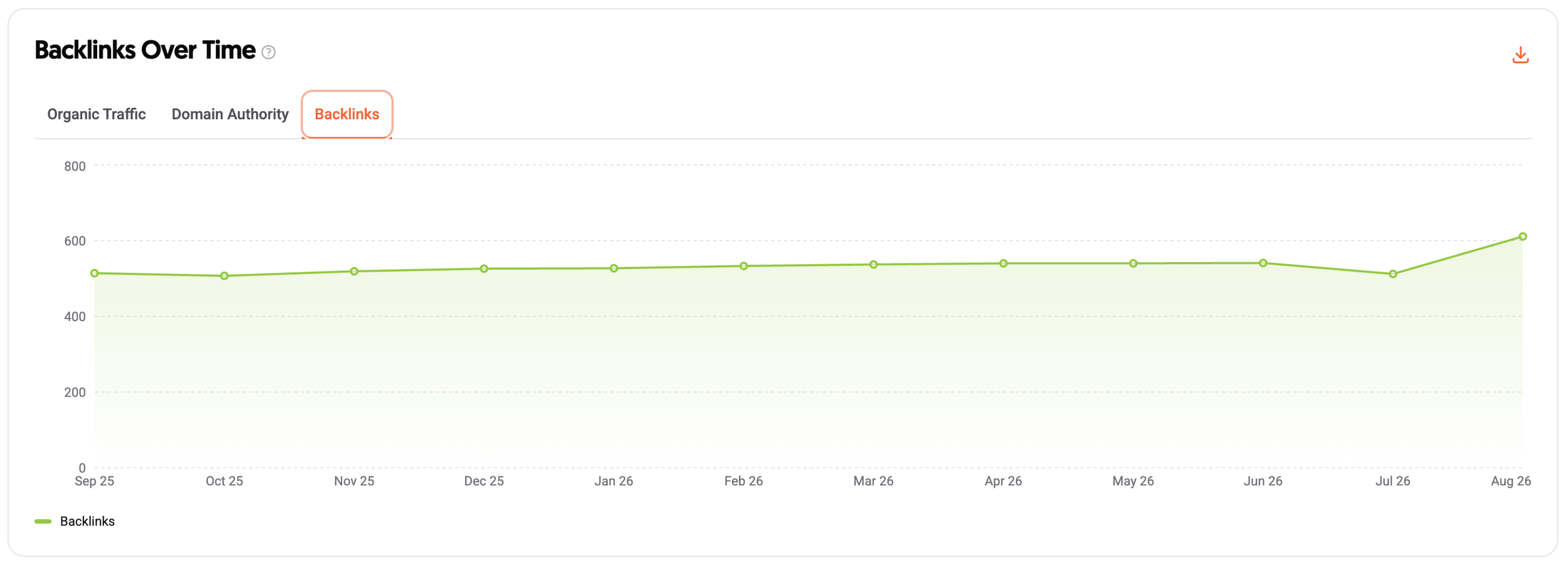
If new backlinks caused the surge, I’d expect them to rise before or alongside it. They didn’t. The later backlink spike arrived after the visibility growth was already underway.
And it wasn’t just wedding season
Another tempting explanation: maybe everyone started Googling wedding venues because it was summer. But the search-demand pattern doesn't fit. For the site's ranking keyword set, demand actually peaks around engagement season and stays comparatively flat through much of spring and summer.
More importantly, estimated visibility for June–September 2026 was around 88 times higher than the same period in 2025. Seasonality doesn't explain an 88x year-over-year difference.
So we're running out of easy suspects.
Unfortunately, Google decided to make this scientifically annoying
There was a Google core update from about May 21 to June 2, which overlaps rather inconveniently with the first big post-redesign increase. Thanks, Google.
That means I can't separate the website changes from whatever changed in Google's ranking systems with any real confidence. To get much closer, I'd need first-party Search Console data, ideally alongside a meaningful control set.
There's another wrinkle: some rankings were already improving before the redesign. One broad “wedding barn” query moved from around #95 into the low 20s while the old site was still live, and another barn-venue query had been climbing before launch too.
So the honest conclusion isn't “the redesign caused the growth.” It's that the redesign appears to have contributed to an upward trajectory that was already underway, and the timing and on-page changes make that contribution plausible.
Less sexy. Much more useful.
Then I found the keyword that lied to me
This is why I don't take SEO-tool traffic estimates literally.
Two variations of “wedding venues near me” accounted for about 26.5% of the entire modeled traffic estimate. The tool had the venue somewhere around positions 34–40 for those huge-volume searches. But when the search was checked from the nearest big city, the site wasn't even on the first two pages.
Remove those two keywords and the apparent non-branded share of modeled traffic drops from 77.8% to 51.3%. That's not a small discrepancy.
Another query taught an equally useful lesson. For “wedding barn locations,” one SEO tool suggested a meaningful ranking. Searched nationally, the venue wasn't visible in the top 35 organic results. Searched from the nearest big city, it was suddenly #1 in the Local Pack and #6 organically.
Same query, very different SERP. Google understands that someone looking for a wedding barn probably isn't after the objectively finest barn on the North American continent. They want one they can actually drive to.
So if you're checking rankings for a wedding venue, location matters enormously. And if an SEO tool tells you you're getting 4,000 visits from something, maybe don't order the champagne until you've checked Search Console.
So what do I think actually moved the needle?
After working through the old site, the new site, ranking history, backlinks, local signals and several complete red herrings, here's where I've landed.
1. The homepage became dramatically easier for Google to understand.
This is the strongest change I can actually see. The new homepage clearly connects the business with barn weddings, wedding venue, [state] and its actual location, and the title, H1, body copy, geographic references and internal structure all reinforce each other. Since almost all of the site's current search visibility belongs to that page, that's a pretty compelling combination of mechanism and evidence.
2. They didn't throw away the authority they already had.
A redesign can improve far more than aesthetics — but it can also destroy existing visibility if the migration is handled badly. Most of the old URLs I checked were redirected properly. Boring, but extremely important. A redesign can absolutely wreck organic visibility when someone launches a beautiful new site and casually changes every URL because /our-magical-barn looked nicer than /weddings. This migration appears to have preserved most of the site's accumulated authority instead.
3. The website finally matched a very strong existing local footprint.
The business already had years of history, reviews, vendor mentions, directories and backlinks. The website didn't create those signals; it seems to have finally lined up with them. That may be the real story here.
4. Google may have helped.
The core update overlaps the first major jump. I can't rule it out, and I'm not going to pretend I can just because it would make the case study cleaner.
Here’s what I DON’T think happened
I don't think the site took off because they started blogging like maniacs, doubled the size of the website, or suddenly earned hundreds of excellent backlinks. They didn't do any of those things.
And I definitely don't think Google read “Where Rustic Charm Meets Timeless Romance” and whispered, “Finally. The information I’ve been waiting for.”
In fact, the new website still gets plenty wrong
This part matters, because it's easy to look at a site that ranks well and assume every decision on it must be brilliant. Nope.
There's no online availability check, even though the venue operates on a fairly restricted season and limited days. There's no instant tour-booking system. Capacity is stated inconsistently in different places, and the same testimonials repeat across about ten pages. Most of the supporting pages earn almost no organic visibility of their own. The positioning is still pretty generic. There are broken redirects, important schema types are missing, image alt text is patchy, and nearly all of the site's organic visibility sits on a single page.
There's even one way I think the old website was better. Its pricing page had a surprising amount of practical information: capacity, payment schedules, insurance requirements, security, alcohol policies, and other things couples genuinely need to know. The new site still publishes pricing (which I very much approve of), but some of that operational detail is now harder to find.
A redesign isn't automatically an improvement in every dimension, and rankings aren't a report card for your whole website.
“Where Rustic Charm Meets Timeless Romance” is still not a great headline
Sorry. I said what I said.
It doesn't tell me why I should choose this barn over another one, or what's unusual about the experience, and you could move it to a wedding venue three states away without changing a word. From a conversion and positioning perspective, I'd want something more specific. The fuzzy, slow-loading video in the hero section doesn’t create a wow effect either.
But here's the other side: it may not matter much to the business right now. If the venue already gets enough qualified demand to fill its available dates, squeezing another 15% out of homepage conversion isn't necessarily the most valuable problem to solve. I don't have their inquiry or booking data, so I can't know whether that's the case.
And that's the bigger point. A weakness on a website isn't automatically a business problem. You have to understand what the business actually needs the website to do.
What I’d steal from this redesign
Not the headline. Not the page design. Not the exact keywords. And definitely not the eleven-city list just because eleven happened to work here. I'd steal the thinking.
Make your category obvious. Don't assume your beautiful photos communicate “wedding venue” to a search engine, or to a couple who landed on your site with no context.
Make your geography obvious. A wedding venue is an intensely local business. Give Google enough to understand where you are and which market you serve.
Put serious effort into the homepage. You don't necessarily need 150 location pages or four blog posts a week. Sometimes the biggest opportunity is sitting right there on /.
Protect what you've already earned when you redesign. Redirect URLs, preserve valuable content, and know which pages rank before you start moving things around.
Don't confuse design, SEO and conversion. They overlap, but they're not the same thing. A site can rank extremely well and still have mediocre positioning. A gorgeous site can be invisible on Google. A strategically brilliant website can still take time to earn authority. And a redesign can improve one of those things while making another slightly worse.
What you absolutely cannot copy
This venue didn't start from zero. It had more than a decade of domain history, nearly 200 Google reviews, years of vendor relationships, wedding directories, photographer backlinks, local relevance, an established brand, and proximity to a major metropolitan market.
You can't recreate fifteen years of business history by copying someone's title tag.
That's why SEO case studies get dangerous when they're boiled down to "They did X. Their traffic increased. Therefore you should do X." Maybe. Or maybe X worked because A through W had been quietly accumulating for ten years. Context matters.
The funny part is that I was trying to sell them a redesign
When I first found this venue, I wasn't doing a case study. I was prospecting. I saw a business whose physical product looked much stronger than its website and thought, there's an opportunity here. So I emailed them. Nothing.
Looking at the timeline now, I strongly suspect they were already working on the new website. I can't prove it, so I won't pretend I know, but the timing certainly makes my unanswered email a lot less mysterious.
And honestly, I'm glad I found them again. Instead of becoming my client, they became something unexpectedly useful: a natural before-and-after experiment I didn't have to design.
The result reinforced something I've become more and more convinced of while studying hundreds of wedding venue websites: your website doesn't need more SEO stuff. It needs to make the right things clear. What you are. Where you are. Why someone should choose you. What they need to know before they inquire. And what Google needs to understand to put you in front of the right people.
This venue still has work it could do. So does almost every website I've ever looked at. But somewhere between the old site and the new one, Google became a lot more confident about what this business was and where it belonged.
I don't think the redesign created the demand. I think it made the venue much easier to match with it. And that may be the most interesting part of the whole story.
A note about the numbers
This analysis uses public website archives, live search results, backlink data and third-party modeled SEO estimates. I don't have access to the venue's Google Search Console, Google Analytics, Google Business Profile Insights, leads or booking data.
That means I can observe timing, rankings, site changes and plausible mechanisms. I can't tell you how many people actually visited the site, how many inquiries the redesign generated, or exactly how much of the visibility increase came from the rebuild.
There was also a Google core update overlapping the initial post-launch increase, some rankings were improving before launch, and third-party SEO tools disagreed substantially on the absolute numbers.
So my conclusion is deliberately narrower: the evidence supports the website rebuild as a contributing factor in the venue's increased organic visibility. It doesn't prove the redesign caused the increase, and it doesn't tell us how big its contribution was.
Not nearly as exciting as a 4,000% traffic headline. But a lot more likely to be true.
Wondering what Google (and couples) actually understand about your venue?
That's the question I'd answer before deciding you need more blog posts, more keywords or a prettier website. I design and strategize websites specifically for wedding venues, starting with the business, the buyer and the search landscape rather than the decoration.
EXPLORE WEDDING VENUE WEBSITE DESIGN →
And if you suspect something isn't working but don't yet know whether the problem is SEO, positioning, your site structure, your booking journey, or something else entirely, that's exactly what my Rabbit Hole Investigations are for.