SEO for Wedding Venues: Get Found and Turn Traffic Into Inquiries
SEO for wedding venues starts with a simple question: can couples who have never heard of your venue find you on Google?
If someone searches for “barn wedding venue Minnesota,” “outdoor wedding venue near Minneapolis,” or “wedding venue with accommodation,” does your website show up?
That's what good SEO should help you accomplish. Not just appear when someone already knows your name, but get discovered by couples who are actively looking for a venue like yours.
In this guide, I'll walk you through the keywords worth targeting, how to structure your website, what matters for local SEO, and how AI search is changing the way couples discover venues.
But we'll also look at what happens after someone finds you.
I've audited more than 100 wedding venue websites, and one thing keeps coming up: some venues struggle to get found, while others get traffic but surprisingly few inquiries. Those are two different problems, and spending more money on SEO won't necessarily solve the second one.
So we'll cover both: how to help the right couples find your venue, and what your website needs to do once they arrive.
What Wedding Venue SEO Actually Does (and Doesn’t Do)
At its core, wedding venue SEO is about helping couples discover your venue when they’re actively looking for somewhere to get married.
That usually means:
optimizing your Google Business Profile
targeting the right location and venue-specific keywords
collecting reviews
making sure your website is fast and works well on mobile
creating useful pages around your location, venue type and features
publishing content that answers things couples are actually searching for
All of that helps Google understand what your venue is, where it is and which searches it should appear for.
But there’s an important distinction:
SEO can create the opportunity to be considered. It can’t make the decision for them.
Once someone clicks, the job changes. Now your website has to help them understand the space, see whether it fits what they’re planning, answer the questions that could rule you out and give them enough confidence to take the next step.
So good wedding venue marketing needs both:
Discovery: Can the right couples find you?
Decision: Once they do, does your website give them a reason to stay?
SEO Keywords for Wedding Venues (With Real Examples You Can Use)
If you want your venue to show up in Google, you need to target the searches couples use before they know your venue exists — not just your venue name.
This is one of the biggest gaps I found while auditing 100+ wedding venue websites.
Many venues show up perfectly well when someone searches for them by name. A couple hears about the venue, types the name into Google and finds the website.
But that’s capturing existing demand.
SEO becomes much more useful when someone who has never heard of you searches for something like “barn wedding venue Minnesota,” “outdoor wedding venue near Minneapolis” or “wedding venue with accommodation” — and discovers you.
You don’t need hundreds of keywords to do this. You need a small set of high-intent searches that accurately describe where you are, what kind of venue you are and what couples can do there.
The 5 Types of SEO Keywords Wedding Venues Should Target
You don’t need hundreds of keywords.
You need a small set of high-intent searches that match how couples actually look for venues.
1. Location-Based Keywords (Most Important)
These are usually the foundation of wedding venue SEO because they match couples actively looking for somewhere to get married in a particular area.
Examples:
barn wedding venue Minnesota
wedding venue Wisconsin
outdoor wedding venue near Minneapolis
rustic wedding venue Twin Cities
Don’t limit yourself to your exact town, either. Think about how couples describe the wider area when searching for venues — nearby cities, counties, regions and destinations may all be relevant.
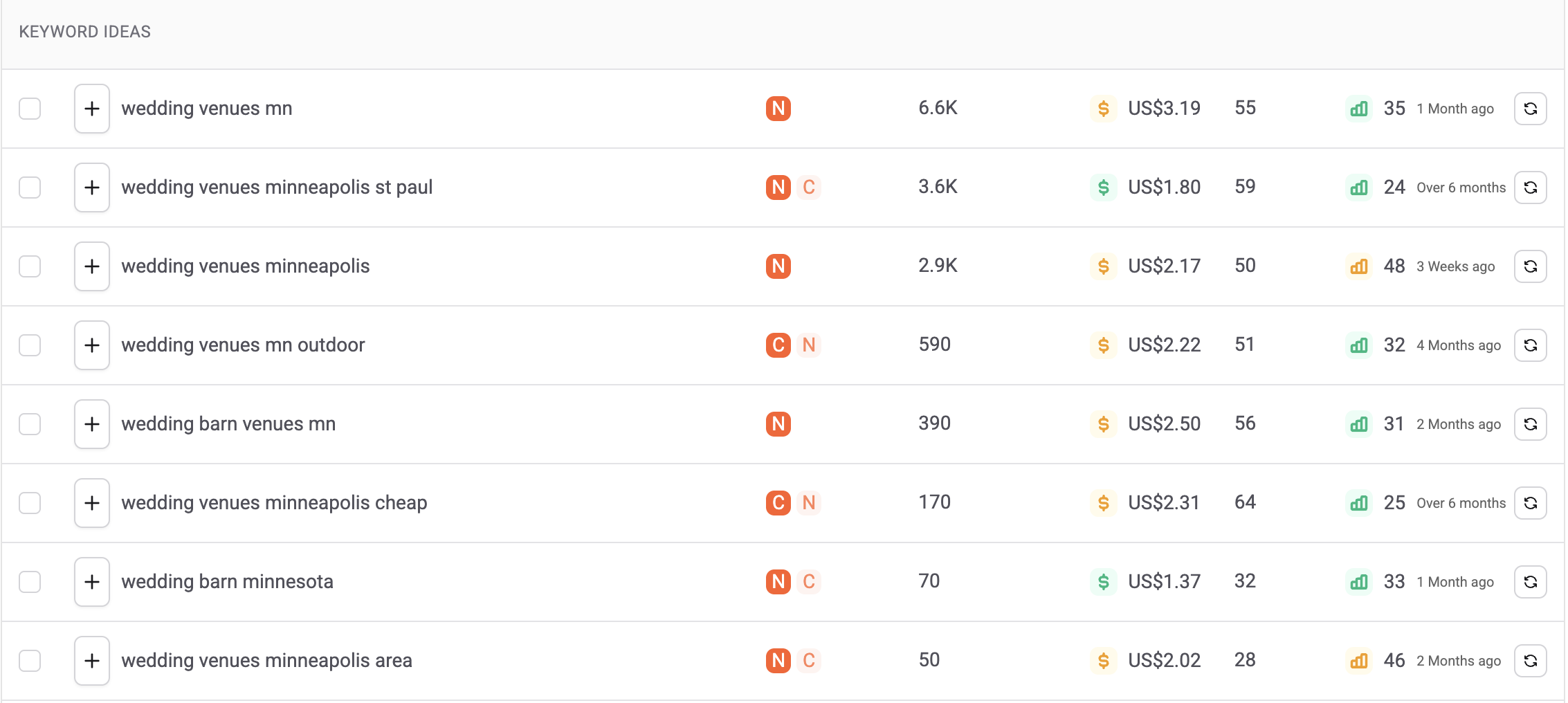
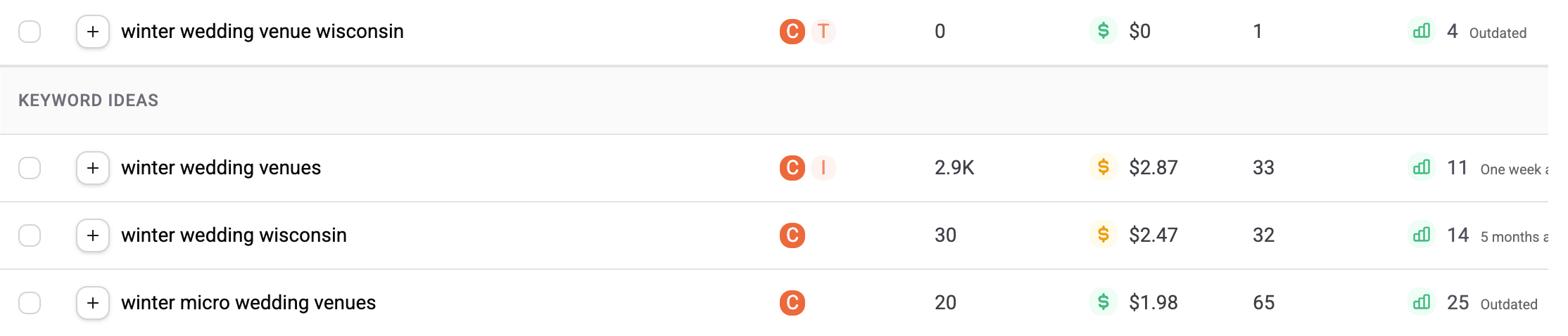
Example of a location-based SEO keyword research
2. Style-Based Keywords
These describe the kind of venue couples already have in mind:
barn wedding venue
garden wedding venue
industrial wedding venue
waterfront wedding venue
Victorian wedding venue
These become much more useful when combined with location, for example:
“barn wedding venue Minnesota”
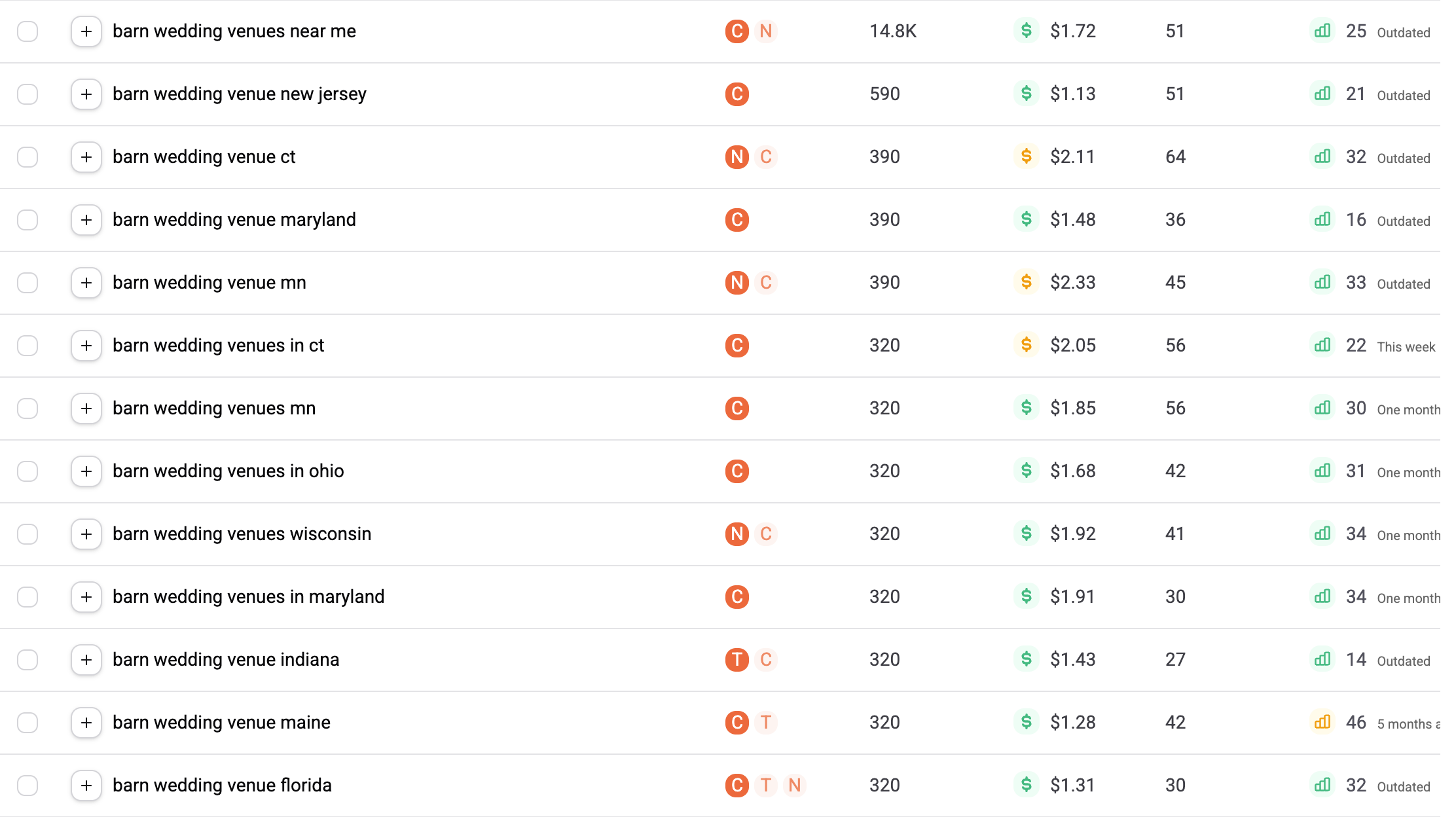
Example of a style-based SEO keyword research for wedding venues
3. Feature-Based Keywords
These are especially interesting because the couple has started narrowing down their options based on actual requirements:
wedding venue with lodging
wedding venue with indoor ceremony option
wedding venue with lake view
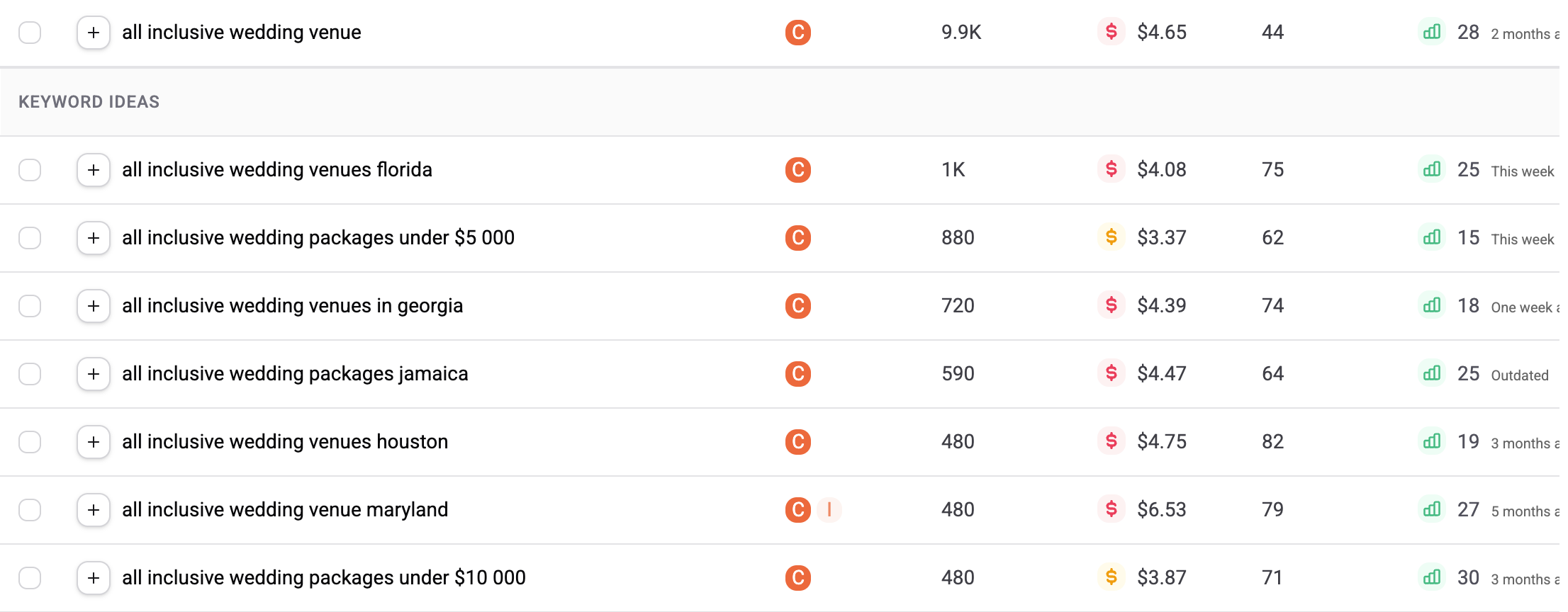
all-inclusive wedding venue
wedding venue for 150 guests
Someone searching for a venue with accommodation isn't just browsing pretty wedding pictures anymore. They're trying to find a venue that can actually work for their wedding.
4. Occasion-Specific Keywords
Not everyone is planning the same kind of wedding. If your venue caters particularly well to smaller or alternative celebrations, those searches can be worth targeting too:
micro wedding venue
small wedding venue
elopement venue
Again, add your location wherever it makes sense.
5. Seasonal & Intent-Based Keywords
These capture couples looking for something more specific:
fall wedding venue Minnesota
winter wedding venue Wisconsin
outdoor summer wedding venue
These searches may have less volume than “wedding venue Minnesota,” but that's not necessarily a bad thing. The person searching is telling you much more about what they actually want.
Wedding Venue SEO Keywords Formulas
These formulas are a starting point, not a list of keywords to copy blindly. The goal is to think about how couples actually search when they don’t already know your venue exists. They might search by location, style, setting, capacity, a must-have feature such as on-site accommodation, or the type of wedding they’re planning. Combining those details creates more specific wedding venue SEO keywords that reflect real buying criteria — and often bring you closer to couples actively narrowing down their options. Use the formulas to generate ideas, then validate them with keyword research and build your website content around the searches that genuinely fit your venue.
| Keyword Formula | Example | Search Intent | Best Used For |
|---|---|---|---|
| [Wedding Venue] + [Location] | Wedding venue Minneapolis | Couples looking for venues in a specific area | Homepage, location pages and Google Business Profile |
| [Style] + [Wedding Venue] + [Location] | Luxury wedding venue Minnesota | Couples looking for a particular venue aesthetic or style | Homepage, venue pages and targeted landing pages |
| [Setting] + [Wedding Venue] + [Location] | Lakefront wedding venue Minnesota | Couples searching by setting or surroundings | Venue pages, galleries and location-focused content |
| [Wedding Venue] + with [Feature] + [Location] | Wedding venue with lodging Minnesota | Couples who already know an important feature they need | Feature pages, accommodation pages, FAQs and blog content |
| [Wedding Type] + [Wedding Venue] + [Location] | Intimate wedding venue Minneapolis | Couples planning a specific type or format of wedding | Dedicated landing pages, packages and blog content |
| [Wedding Venue] + for [Guest Count] + [Location] | Wedding venue for 150 guests Minnesota | Couples narrowing venues based on capacity | Capacity information, venue pages and FAQs |
| [Season] + [Wedding Venue] + [Location] | Winter wedding venue Minnesota | Couples planning around a particular season | Seasonal landing pages, galleries and blog content |
| Best + [Wedding Venue Type] + [Location] | Best outdoor wedding venues in Minnesota | Couples comparing venues before creating a shortlist | Blog posts, guides and comparison content |
| [Question] + [Wedding Venue] + [Location] | How much does a wedding venue cost in Minnesota? | Couples researching before or during the venue search | Blog posts, pricing pages and FAQs |
How to Actually Use Wedding Venue SEO Keywords
You don’t need to cram every variation onto your homepage.
A simple structure works:
Homepage → your main venue + location search
Barn wedding venue in Minnesota
Dedicated pages → important features, locations or types of weddings
Wedding venue with lodging in Minnesota
Blog/content → useful questions, seasonal searches and specific planning needs
What to Know About Planning a Winter Wedding in Minnesota
The goal isn't to mention “Minnesota wedding venue” seventeen times.
It's to create pages that genuinely deserve to appear when someone makes those searches.
I found a particularly interesting example of this when I reverse-engineered a wedding venue whose Google visibility exploded after a website redesign.
SEO for Wedding Venues in the Age of AI Search
There’s another reason to be specific about your venue now: people aren’t only discovering wedding venues through a traditional list of Google results anymore.
Google has AI Overviews and AI Mode. People are asking ChatGPT increasingly specific questions. Search is becoming less “show me ten wedding venue websites” and more:
“Find me a wedding venue near Minneapolis for 120 guests with accommodation, an outdoor ceremony space and a good rain backup.”
That changes something important.
Search engines and AI systems need to be able to understand what your venue actually offers if they’re going to surface it as a relevant answer.
And “a magical setting for your unforgettable day” doesn't tell them very much.
Neither does “where timeless elegance meets modern romance.”
What does?
120-person capacity.
On-site accommodation for 24 guests.
Indoor and outdoor ceremony spaces.
Twenty minutes from downtown Minneapolis.
Wheelchair accessible.
Starting at $6,500.
Available for winter weddings.
Specific information gives search systems something useful to work with.
And conveniently, it's exactly the information couples are looking for too.
Clarity now has two audiences
The couple needs to understand whether your venue could work for their wedding.
Search engines and AI systems need to understand when your venue could be a relevant answer.
That doesn't mean you need a mysterious new “AI SEO” strategy. Google itself says the fundamentals haven't suddenly changed: useful content, clear information, crawlable pages, good internal structure, accurate business information and technically sound SEO still matter.
It means the vague wedding-industry copy that was never particularly helpful to humans is becoming even less useful.
The clearer you are about what you offer, who it's for and where you are, the easier you make the job for both humans and machines.
The Problem Starts the Moment Someone Clicks
Here’s where things get interesting — and a little uncomfortable.
Someone finds you on Google. They click through to your website. And within a few seconds, something quiet happens… They don’t think this is awful. They don’t even necessarily think I don’t like it.
It’s more like: I’m not sure this is the one.
So they leave. They open another tab. They keep comparing. And you never hear from them.
No bounce notification. No feedback. They’re just gone.
And wedding venues are particularly vulnerable to this because couples aren’t looking at your website in isolation. They’re comparing you with five, ten, sometimes twenty other venues.
They’re trying to answer very practical questions surprisingly quickly:
Can I actually see the venue properly?
Does it fit our guest count?
Can we have the ceremony and reception here?
What happens if it rains?
Is there accommodation?
Is this remotely within our budget?
What’s included?
What do we do if we want to see it?
And then there are the questions they probably won’t consciously articulate:
Does this place feel right for us?
Do I trust these people with our wedding?
Can I picture the day here?
If your website makes those answers difficult to find, the couple doesn’t necessarily contact you to ask.
They have another venue open in the next tab.
The Leak You Can’t See…
This is the part that most venue owners miss entirely, because the website isn't failing loudly. There's no obvious error. No broken page. It's just quietly leaking.
You're getting the right people, at the right time, with real buying intent — and still losing them. Not because of anything wrong with your traffic. But because the experience on your site isn't helping them make a decision.
SEO is about getting people to visit your website.
But it doesn't explain your space clearly. It doesn't build confidence. It doesn't reduce hesitation or guide someone toward reaching out. So when venues pour more budget into wedding venue SEO without addressing what happens after the click, they're not solving the problem — they're just sending more people into the same leak.
More traffic into a broken funnel is still a broken funnel.
What Actually Turns Rankings Into Inquiries
Once the right couples are finding your website, the question changes.
It’s no longer how do we get more traffic?
It’s what does someone need to see before they feel comfortable inquiring?
After looking at 100+ wedding venue websites, I kept seeing the same things getting in the way.
01/ Let people actually see the venue
This sounds ridiculously obvious, but it’s surprisingly common to land on a wedding venue website and struggle to get a clear sense of the place. There are beautiful close-ups of table settings. A bride getting ready. Flowers. A champagne tower. Maybe a gorgeous sunset.
But where does the ceremony happen?
What does the reception space look like with 120 people in it?
What’s outside? What’s inside? What happens if it rains?
Couples aren’t just looking for beautiful photography. They’re trying to mentally put their wedding into your space.
02/ Make the practical information easy to find
Capacity. Pricing. What’s included. Accommodation. Ceremony options. Accessibility. Location. These aren't boring details to hide until the inquiry. They’re part of how someone decides whether it’s even worth inquiring.
The harder you make couples work to find basic information, the easier it is to keep comparing somewhere else.
03/ Give them some idea of price
You don't necessarily need to publish every package and add-on. But giving no indication whatsoever of what your venue costs creates another decision the couple has to make:
Is it worth contacting them just to find out whether we can afford it?
A starting price, typical range or downloadable pricing guide can answer that question without forcing someone into an inquiry first.
04/ Show what makes this venue different
This is another pattern I found constantly. Beautiful venue. Beautiful website. And copy that could belong to almost any other wedding venue in the country.
Unforgettable celebrations. Your dream day. Memories to last a lifetime.
Couples are comparing a lot of venues that are all promising essentially the same thing.
Give them something specific to remember.
05/ Make the next step obvious
If someone likes what they see, don't make them hunt for what happens next. Book a tour. Check availability. Request the pricing guide. Send an inquiry.
Whatever your next step is, make it clear.
The job of the website isn't to convince every couple to contact you.
It's to help the right couple get from this looks interesting to I want to know more with as little uncertainty as possible.
The Wedding Venue SEO Diagnostic: What Problem Do You Actually Have?
Before you hire an SEO expert, publish another 20 blog posts or start rewriting every page on your website, figure out where the problem actually is. Because “we need better SEO” can describe several completely different problems.
Here’s the simplest way I’ve found to think about it.
1. Nobody finds you unless they already know your name
You probably have a discovery problem.
Search your venue name and you appear everywhere. Great.
Now try the searches a couple might use if they had never heard of you:
“wedding venue near [city]”
“barn wedding venue [region]”
“wedding venue with accommodation [location]”
If you're nowhere to be found, this is where SEO can genuinely help.
Look at your keyword targeting, location pages, Google Business Profile, website structure, local authority and the searches your ideal couples are actually making.
Your priority: get discovered.
2. You appear in Google, but hardly anyone clicks
You may have a search-result problem.
Ranking isn't particularly useful if everyone scrolls past you.
Look at which searches you're appearing for in Google Search Console and compare your result with everything around it.
Does your title actually match what the person searched for?
Does it give them a reason to choose your result?
Are you appearing for relevant searches — or getting impressions from people looking for something slightly different?
Your priority: earn the click.
3. People click, but very few inquire
You probably don't need more traffic yet.
This is where I'd look at the website.
Can couples quickly understand what your venue is like?
Can they see the spaces properly?
Can they find capacity, pricing or some indication of budget, what's included, accommodation, ceremony options and other information they need to decide whether you're a possibility?
Can they tell what makes you different from the other twelve venues they've opened?
If people are already arriving and consistently disappearing, sending more people there may simply create a bigger version of the same problem.
Your priority: find out what's stopping the decision.
4. People inquire, but the inquiries are mostly wrong
You may have a qualification problem.
Lots of inquiries sounds good until half of them disappear when they see the price, need a capacity you can't accommodate or want something you don't offer.
That can mean your website is doing too little filtering before someone contacts you.
More leads aren't necessarily the goal.
More of the right leads are.
Your pricing, positioning, practical information and messaging should help unsuitable couples rule you out — while giving the right ones more reasons to continue.
Your priority: improve the fit of the inquiries, not the number.
5. You get good inquiries, but they don’t turn into tours or bookings
This probably isn't an SEO problem anymore.
At this point I'd start looking further down the journey.
How quickly do you respond?
What happens after the inquiry?
What information do couples receive?
How easy is it to arrange a tour?
What happens during and after it?
What are they comparing you with?
SEO did its job several steps ago.
Your priority: investigate what happens between the inquiry and the yes.
So, do you actually need better wedding venue SEO?
Maybe.
If the right people can't discover you, yes — very possibly.
But if you're already getting found, getting clicks or even getting inquiries, I'd be careful about automatically prescribing “more traffic.”
Look at where people disappear.
That's the problem worth fixing.
And if you're looking at your analytics thinking okay, but I have absolutely no idea where they're disappearing — that's exactly the kind of mystery I like.

Not sure SEO is actually your problem?
I occasionally take one established business down a Rabbit Hole: I investigate the website, traffic, competitors and customer journey to figure out what's actually stopping people from saying yes.
One Last Thought About SEO for Wedding Venues…
Good wedding venue SEO gets you into the consideration set. Your website does the rest.
Sometimes the problem is visibility. Sometimes it's the click. Sometimes couples arrive, look around and quietly disappear. And sometimes you're getting plenty of inquiries — just not the right ones.
The important part is knowing which problem you're trying to solve before you spend money solving it.
SEO for Wedding Venues - FAQs
-
Start by checking whether Google understands three things clearly: what you are, where you are and what makes your venue relevant to the searches couples are making.
Your website should target a primary location-based search such as “wedding venue in [location],” while individual pages can target more specific searches around your venue type, features and the weddings you host.
Your Google Business Profile, reviews, local mentions and links from relevant wedding vendors and directories also help establish where your venue is and what it should appear for.
And test this without using your venue name. Being easy to find when someone already knows you exist is very different from being discovered by a couple who has never heard of you.
-
Usually, the best keywords aren't the ones with the biggest search volume. They're the ones that accurately describe what a couple is looking for and what you actually offer.
Start with combinations of:
Location: wedding venue Minnesota
Style: barn wedding venue Minnesota
Features: wedding venue with accommodation Minnesota
Size: small wedding venue Minnesota
Occasion: micro wedding venue Minnesota
Season: winter wedding venue MinnesotaThe more specific the search becomes, the fewer people may search for it — but those people are often much further into the process of choosing a venue.
-
Yes — if being found is actually the problem.
If your venue barely appears when couples search for venues like yours in your area, improving your SEO can put you in front of people who would otherwise never know you exist.
But if you're already ranking, getting traffic and still not getting enough good inquiries, I'd investigate the website and customer journey before spending more money on traffic.
SEO is valuable. It just isn't the solution to every visibility, inquiry or booking problem.
-
Make sure your Google Business Profile is complete and accurate, keep your business information consistent across the web, collect genuine reviews and make your location clear throughout your website.
Your website should also give Google more geographical context than simply putting your address in the footer.
Mention the city or region you serve naturally in your page titles, headings and copy, and create genuinely useful content about getting married in your area where it makes sense.
Links and mentions from local planners, photographers, tourism websites, publications and other relevant businesses can strengthen those local signals too.
-
Yes, but passing a technical mobile-friendly test is only part of the job.
Most couples will encounter your venue while browsing on their phones, so ask a more useful question:
Can someone actually evaluate the venue on a small screen?
They should be able to see the spaces, understand your capacity, find pricing information, check important practical details and figure out how to inquire without fighting tiny text, slow galleries, intrusive pop-ups or confusing navigation.
A technically responsive website can still be a terrible mobile experience.
-
There isn't a universal timeline.
If Google already understands your website and you're sitting just outside the top results for an important search, relatively small improvements may make a difference.
If your website has very little authority, weak location signals, poor content or significant technical problems, improving visibility can take much longer.
That's why I'd look at your existing Google Search Console data before making promises about how long SEO will take. It shows what Google is already associating your venue with — and how far you actually have to go.
-
A lot of the basics can absolutely be done yourself.
You can optimize your Google Business Profile, improve page titles, collect reviews, make your location clearer, add useful information to your website and create pages around searches that genuinely matter to your couples.
I'd consider getting help when you don't know why you're not getting results.
If you can't tell whether the problem is rankings, the searches you're targeting, low click-through rates, the website itself or what happens after someone inquires, blindly doing “more SEO” gets expensive quickly.
At that point, the first thing you need isn't necessarily more SEO.
You need a diagnosis.