Why Your Website Isn’t Getting You Clients — And Why It Might Not Be a Website Problem
Your website looks good.
Your services are there. Your portfolio is there. You have testimonials and a contact form. Maybe you've spent months improving your SEO, rewriting your copy, changing buttons, adding calls to action and wondering whether your homepage needs another redesign.
And still: Your website isn't generating leads.
Or perhaps you're getting traffic, but those visitors aren't turning into inquiries. Maybe people inquire but don't buy. Maybe something that used to work has mysteriously stopped working.
So naturally, you assume something is wrong with your website.
Maybe.
But there's another possibility:
Your website is working perfectly well. The problem is somewhere else.
A website is only one part of the system that turns a stranger into a customer. Visibility, traffic quality, positioning, demand, trust, your offer, your competitors and even what happens after somebody submits your contact form can all determine whether you get the sale.
Until you know where that system is breaking, changing the website is mostly guesswork.
And a redesign is a very expensive way to guess.
First: how do you know if your website is actually the problem?
People talk about websites as though they generate customers by themselves…. But they don't. Before somebody becomes a client, they have to move through an entire chain:
Market → Visibility → Traffic → Perception → Desire → Trust → Action → Sales
Your website participates in that process. It doesn't control all of it.
If nobody knows you exist, changing your homepage won't help. If Google sends you 5,000 visitors who would never buy from you, improving your conversion rate isn't the first problem I'd solve. If the right people arrive but don't understand why they should choose you, now we may have a website problem.
And if qualified leads inquire and then disappear after receiving your proposal?
Your website may have already done its job.
So when a business owner tells me, “My website isn't getting me clients,” I don't immediately start looking for things to change.
I want to know: Where are people actually disappearing?
If your website isn’t generating leads, start here
You don't need to know the answer yet. Start with what you're actually observing, then investigate the most likely layer of the problem.
| What You’re Seeing | What I’d Investigate First |
|---|---|
| Hardly anyone relevant reaches the website | Visibility, SEO, distribution and demand |
| You’re getting traffic, but it isn’t the right people | Search intent, targeting, traffic sources and old content attracting the wrong audience |
| The right people arrive but don’t seem to understand what you do | Positioning, messaging and offer clarity |
| People love, admire or engage with what you sell—but don’t buy | Desire, perceived value and what they’re actually hoping the purchase will do for them |
| People seem to want it, but hesitate | Trust, uncertainty, risk, proof and unanswered questions |
| People understand and want the outcome, but your offer isn’t appealing | Offer structure, pricing, alternatives and perceived value |
| People know they have a problem but aren’t looking for your type of solution | Market awareness, education and competition between different ways of solving the problem |
| People keep postponing the purchase | Urgency, the cost of staying the same and “do nothing” as a competitor |
| People choose other businesses instead | Provider-level competition: positioning, proof, reputation, experience, ease and buying friction |
| People inquire but don’t become customers | Sales process, response, pricing conversations, proposals, objections and follow-up |
| Something that used to work has stopped working | Changes in the market, customer preferences, competitors, alternatives or demand |
| Everything above looks healthy, but people still disappear on the website | Now we investigate the website itself: UX, information architecture, messaging, friction, mobile experience and conversion |
The point isn't to diagnose a business from one row in a table. It's to know where to start looking.
Because all twelve businesses could describe their problem in exactly the same way: “My website isn't getting me clients.”
And need twelve completely different fixes.
1. You may have a visibility problem
Start with the simplest question:
Are enough of the right people actually reaching your website?
And here's where it gets interesting: a website can be “SEO optimized” and still have a visibility problem.
I saw this recently while investigating a service business whose website appeared, on the surface, to have done SEO properly. The important service and location phrases were there. The pages were optimized around relevant keywords. Search for one of those exact phrases in quotation marks and the website appeared right at the top. It looked like SEO was working…
Then I searched the way an actual potential customer would.
Without quotation marks, the business was practically invisible.
That little discrepancy told me something much bigger.
The website was optimized for a version of SEO that used to work very well: choose the keyword, put it in the right places, create a relevant page and optimize that page around the phrase.
But search has changed.
Today I'm much more interested in the broader search landscape around a business: what potential customers actually type, which questions they ask, which businesses Google consistently associates with the topic, what kinds of pages are being rewarded, which competitors occupy the search results and whether the website has enough topical relevance and authority to compete across that landscape.
So “my website is optimized for SEO” and “my business is visible in search” aren't necessarily the same thing. And that's why simply checking whether you rank for a keyword can give you false confidence.
The useful question is:
When potential customers go looking for what you do, how often do they actually encounter you?
If the answer is “rarely,” we don't have enough evidence to blame the website's conversion rate yet. Potential clients can't convert on a website they never find. Sometimes “my website isn't bringing me clients” actually means:
My potential clients aren't finding my website in the first place.
2. You may have traffic, but it’s the wrong traffic
This is where website analytics can become wonderfully misleading.
You have traffic!!! Excellent. But who are those people?
I worked with a therapist whose website was already getting organic traffic from Google. At first glance, that sounds like good news. SEO was working. Then I looked at what people were actually searching for. A significant part of that visibility came from academic and informational searches related to psychology. People were finding his articles because they answered interesting questions—but many of those searchers weren't looking for a therapist.
Google liked the content. The traffic was real.
It just wasn't necessarily client traffic.
I have an even more annoying example on my own website.
Years ago, when I was deliberately trying to attract a more spiritual crowd, I wrote a post about zodiac signs.
It worked.
Unfortunately, Google has a very long memory. 😂
My business moved on. The zodiac people did not. So while I was now selling website strategy and multi-thousand-dollar website projects, most of my organic traffic was still arriving because Google apparently considered me an authority on astrology. And now it breaks my heart to just kill it.
The post isn’t failing. It’s still attracting exactly the audience I'd originally created it for.
I just don’t want that audience anymore.
And that's another reason traffic numbers can be misleading:
Sometimes your traffic belongs to a previous version of your business.
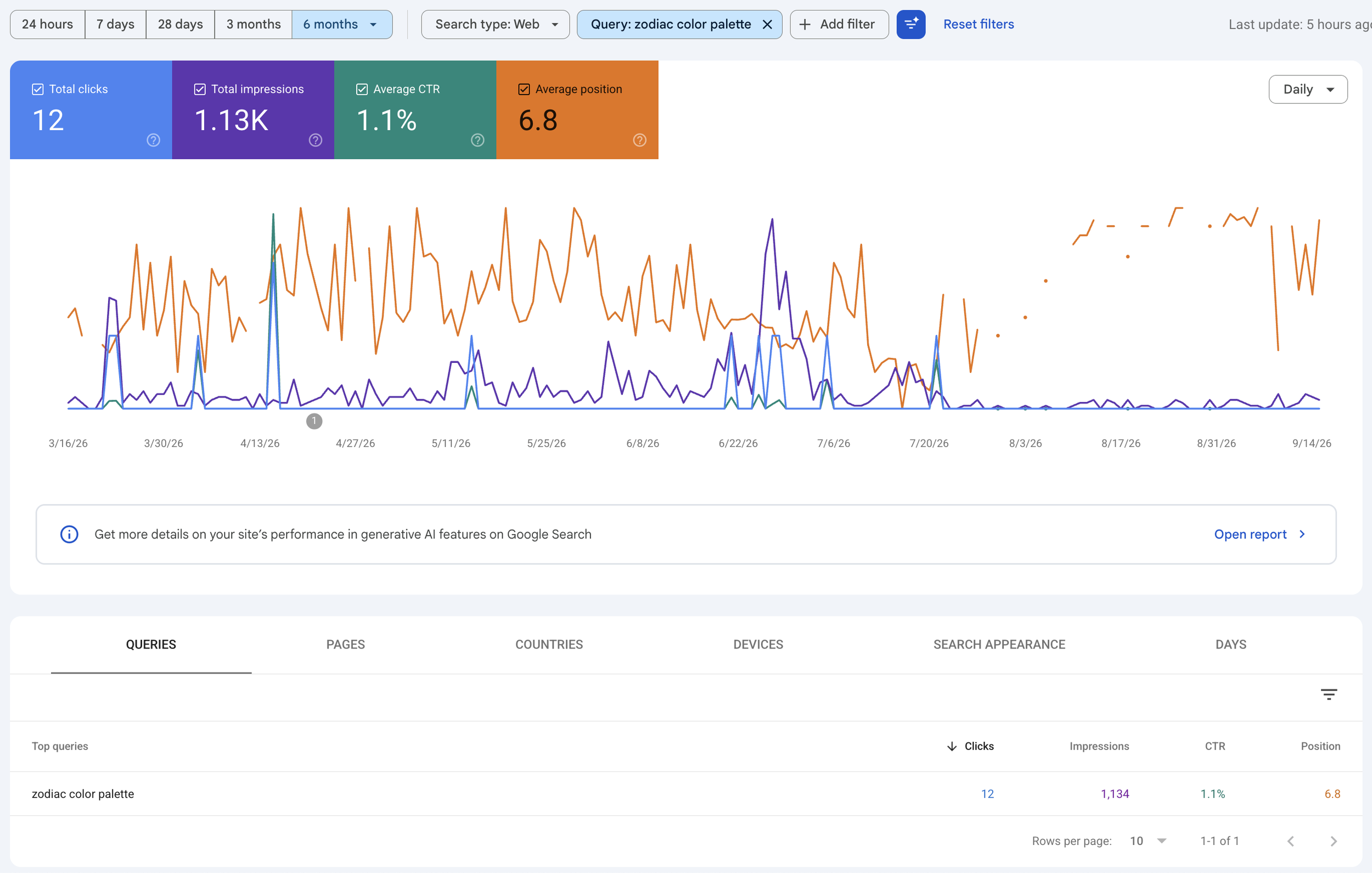
traffic I absolutely do not need anymore 😂 Sometimes your traffic belongs to a previous version of your business.
If we'd looked only at total organic traffic and the number of inquiries, we could have concluded that the website had a conversion problem. But asking the website to convert someone who arrived looking for information rather than therapy isn't really a conversion problem.
The better question becomes: How much of your search visibility comes from people who could realistically become clients?
And this happens in all kinds of businesses…
A blog post can bring thousands of visitors who will never buy what you sell.
A photographer can get enormous attention from people who simply enjoy looking at their work.
A wedding venue can attract couples outside its realistic geographic market.
A local service business can rank internationally while only serving one city.
A website designer can rank for DIY tutorials read almost exclusively by people who have no intention of hiring a designer.
Traffic isn't automatically an audience. And more traffic doesn't necessarily mean more clients.
The question I care about is: Are people with the right problem, enough desire and the ability to buy actually reaching you?
If not, we don't have a conversion problem yet.
We have a targeting or acquisition problem.
And trying to increase the conversion rate of irrelevant traffic is a very efficient way to spend money solving absolutely nothing.
3. The right people may be arriving, but they don’t understand why they should choose you
Now we're getting closer to the actual website territory.
A potential customer lands on your site…. They scroll. They look at the photographs. They read a little. And they think: This looks nice. Lovely.
Unfortunately, “this looks nice” isn't a buying decision.
They need to understand what you do, whether it's for someone like them, what they'll get, why it matters and—especially in a competitive market—why they should choose you instead of another option.
This is where beautiful websites sometimes fail spectacularly…. They communicate an aesthetic without communicating a reason to buy.
I've reviewed websites where I could immediately tell that the designer was talented, but after several minutes I still couldn't confidently answer: Why would I hire this business instead of one of the other ten tabs I have open?
That's not necessarily a design problem. It may be a positioning problem. Or a messaging problem.
Or both.
And redesigning the website without answering that question can simply give you a much prettier version of the same problem.
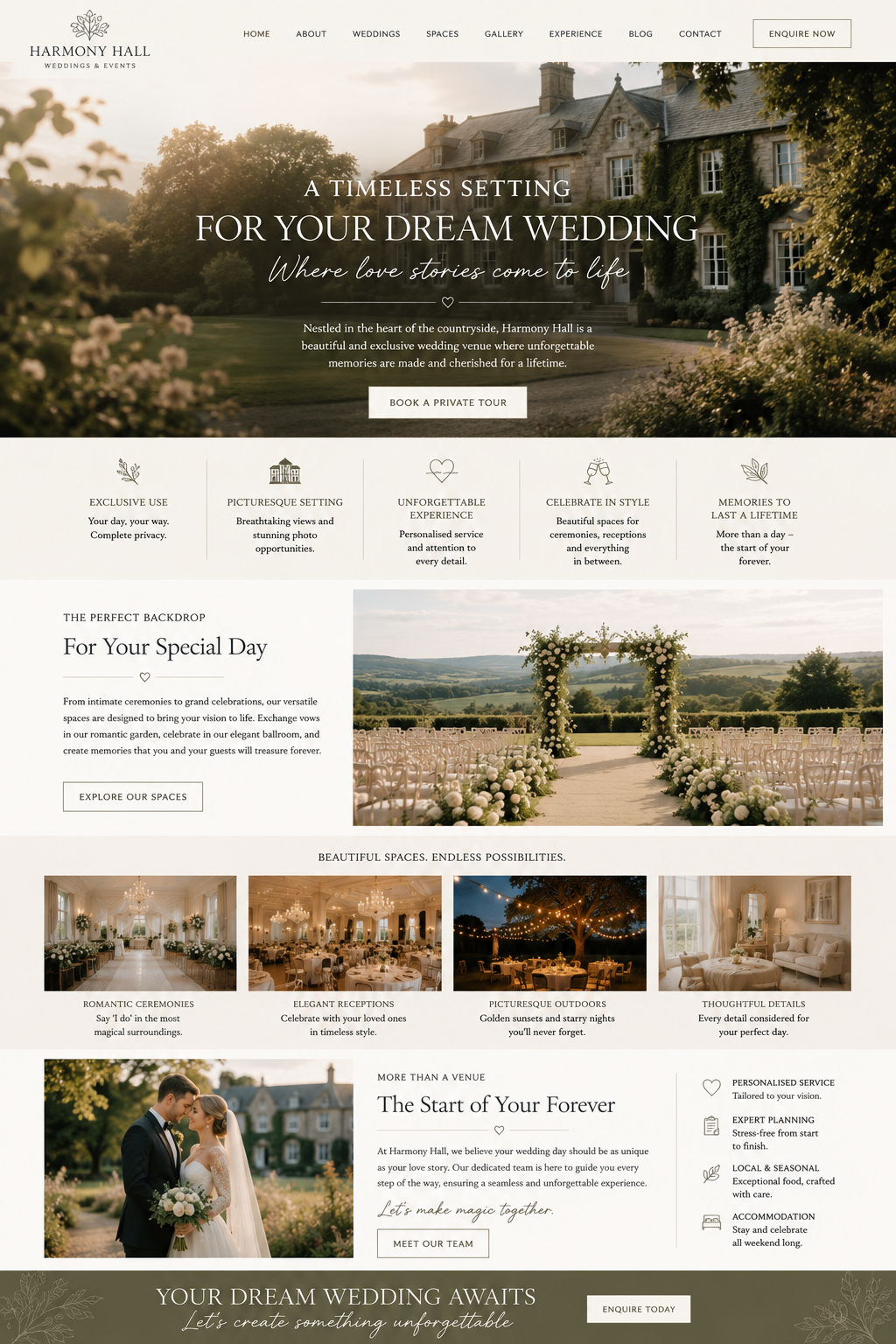
150 guests? Rain plan? Pricing? Accommodation? What's included? A beautiful website can create desire and still leave the customer without enough information to make a decision.
4. People may like what you’re selling without wanting it enough to buy
This is one of my favorite discrepancies.
People love the work. They compliment it. They share it. They spend time looking at it.
And still: they don't buy.
I've seen this recently in two very different businesses. One sells art. Another sells jewelry. In both cases, the work itself gets a genuinely positive response. So the obvious explanation—maybe people just don't like it—doesn't quite fit.
But admiration isn't the same thing as desire.
Someone can look at a photograph and think: “That's incredible.” That's different from: “I want that in my home enough to pay $2,000 for it.” Someone can admire a beautifully made piece of jewelry without wanting to own it.
This is actually me.
I admire beautiful or cool things all the time, but I rarely feel any need to own them. Looking at something beautiful already gives me quite a lot of pleasure. When I do buy things, usefulness tends to win.
So if you showed me a beautiful $2,000 necklace and I spent ten minutes admiring every detail of it, you might reasonably think: Excellent. She loves it.
I do. I can even afford it.
And I'm still not buying the necklace. 😂
And that's when the more interesting question becomes: What are people actually buying? Because almost nobody is buying only the literal thing you're selling. They're buying what they believe it will do for them.
For someone else, that same necklace might represent status. Identity. A reward. A memory. Belonging. Self-expression. An anniversary. Becoming the kind of person who owns things like this.
The object hasn't changed. The job it is doing for the customer has.
And this applies far beyond jewelry.
A wedding venue isn't just a building for twelve hours. Pilates isn't just controlled movement on an expensive medieval-looking contraption 😂 And therapy certainly isn't fifty minutes of talking in a room.
People may be buying a solution to a problem. Ease. Relief. Certainty. Status. Belonging. Recognition. Transformation. A particular feeling. A story about themselves. A version of the future they want to move toward. Sometimes the goal is obvious, and sometimes the most powerful reason for buying is the one nobody has actually said out loud. So when people consistently admire something without buying it, I don't immediately conclude that the website needs stronger CTAs.
I want to know: What does owning this, booking this or choosing this allow the customer to become, feel, solve, avoid or signal? And is the business actually connecting the product to that desire?
Maybe the wrong people are seeing it…
Maybe the value doesn't justify the price…
Maybe there's a better alternative…
Maybe people appreciate the work aesthetically but can't imagine it in their own lives…
Maybe the business is selling the product while customers are actually shopping for the outcome underneath it…
Or yes, maybe the website is getting in the way.
But “people love it and they don't buy it” is a symptom, not a diagnosis.
And the discrepancy is information.
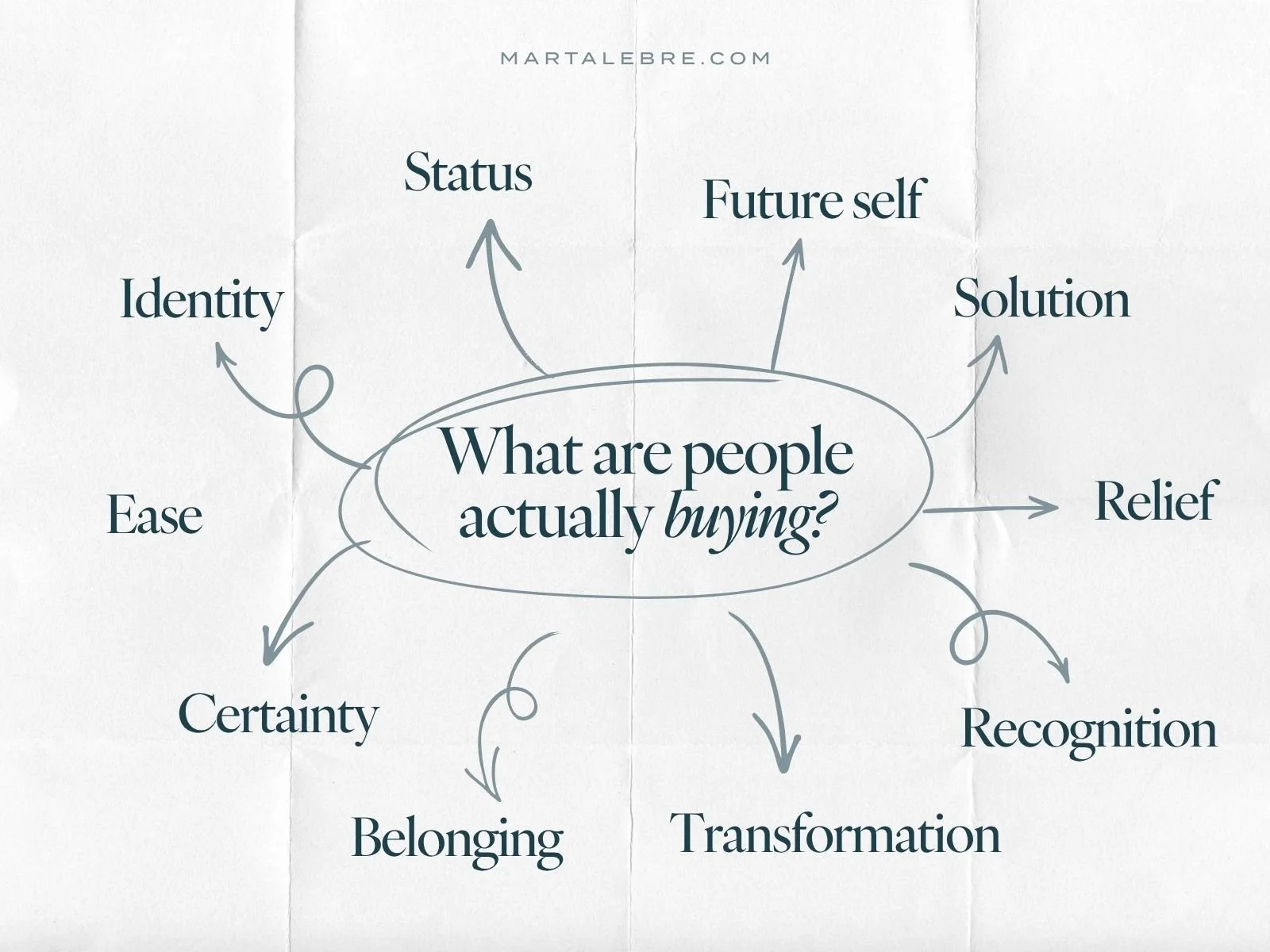
The product is visible. The job it performs for the customer often isn't.
5. They may want it, but they don’t trust the decision yet
Sometimes desire isn't the problem at all.
Wedding venues are a perfect example. A couple lands on a venue website and loves what they see. The building is beautiful. The ceremony space looks incredible. The photographs match what they've imagined. They can already picture themselves getting married there.
They want it.
And they still don't inquire because wanting something and feeling safe enough to make a decision about it are different things.
A wedding venue isn't a casual purchase. The couple is choosing a place for an expensive event that happens once, involves dozens or hundreds of other people and comes with a spectacular number of opportunities for something to go wrong.
So while the website is showing them beautiful photographs, they're quietly wondering:
Can it actually fit our guests?
What happens if it rains?
Where does everyone stay?
What's included?
What will this really cost us?
Can we use our own vendors?
What happens between booking and the wedding?
Will our grandparents be comfortable here?
Is there somewhere to get ready?
Are there hidden restrictions we're going to discover later?
What if we book it and regret the decision?
That's why I think so many beautiful wedding venue websites underperform. They create desire beautifully. But they don't create enough certainty and trust. The site behaves like a perfume ad when the couple is trying to make a complicated logistical and financial decision.
And this isn't unique to wedding venues.
The more expensive, unfamiliar or consequential a purchase becomes, the more questions a potential customer needs answered before they're comfortable taking the next step.
This is why I often say: People aren't only buying the outcome. They're buying certainty.
Testimonials, case studies, detailed FAQs, process explanations, pricing context, specifications, policies, photographs that answer practical questions and clear information architecture aren't boring extras we add after the “important” marketing. They're part of the selling. They reduce uncertainty.
So if people appear to want what you sell but aren't taking the next step, I want to know:
What are they still uncertain about?
Because sometimes the problem isn't creating more desire but rather making the decision feel safe enough to make.
6. Your offer may be the problem
Here's a particularly annoying possibility: your website explains your offer perfectly and people understand it. They just don't think it's compelling enough.
That distinction matters. You can rewrite the copy around an offer seventeen times without changing the underlying economics of the decision.
Maybe the service is too broad…
Maybe the customer doesn't understand why they need it now…
Maybe your competitors package the same solution in a way that's easier to understand or easier to buy…
Maybe the price-to-perceived-value relationship doesn't make sense…
Maybe customers want part of what you're selling, but not the whole package…
Maybe your service solves a real problem—but not one they consider important enough to pay to solve…
If that's what the evidence tells us, changing your homepage headline isn't strategy.
It's decorating the problem.
7. Your market may not know your solution exists yet
Sometimes people aren't searching for what you sell, and it’s not because they don't have the problem.
They just don't know your solution exists.
I worked on a business that sold ready-made garden designs. The idea filled a very logical gap. At one end of the market, homeowners could design the garden themselves. At the other, they could hire a landscape designer for a completely bespoke project.
This business offered something in between: a professionally designed garden without the cost of commissioning a custom design.
There was a plausible customer for it, too: someone who cared about how their garden looked, wanted something more considered than DIY, but wasn't looking to spend on full-service landscape design.
There was just one problem. People weren't looking for ready-made garden designs.
The category wasn't established enough in that market.
Potential customers were much more likely to be thinking:
What should I plant here?
How do I make my garden look professionally designed?
I can't afford a landscape designer.
How do I design this myself?
The underlying desire existed, but people didn't necessarily know there was a product sitting between “figure it out yourself” and “hire someone to do it for you.” That's a completely different marketing problem from competing in an established category.
If someone needs a wedding venue, they know wedding venues exist. They're going to look for one.
If someone needs an accountant, they know accountants exist.
But when you're selling a new or unfamiliar way of solving a familiar problem, potential customers may never search for the name of your solution.
You have to meet them at the problem. And sometimes you have to teach the market that another option exists before you can persuade anyone to choose yours.
So a perfectly optimized website can sit there waiting to capture demand that barely exists yet.
That's not necessarily a conversion problem or an SEO problem.
And it doesn't necessarily mean the idea is bad.
It means the first question is much more fundamental:
Do people want the outcome—and do they know that this is one of the ways they can get it?
8. Your market may have changed
Sometimes the most confusing version of this problem sounds like: “But this used to work.”
Same business. Same quality of work. Maybe even a better website.
Fewer clients.
That's when I want to know what changed outside the website.
Wedding photography is a fascinating example. For years, a photographer could build a successful business around a particular visual style, editing aesthetic and carefully polished final gallery. Then the aesthetic started shifting.
Younger couples began gravitating toward imagery that feels more candid, immediate and imperfect. Flash photography. Movement. Grain. Blurry frames. Behind-the-scenes moments. Images that feel less like a carefully produced wedding editorial and more like being inside the night itself.
And then another category started appearing alongside traditional wedding photography: wedding content creators.
Someone capturing vertical video, phone footage and raw little moments throughout the day—often delivered almost immediately rather than weeks later as part of a meticulously edited gallery.
That doesn't mean couples suddenly stopped valuing professional photography. And it certainly doesn't mean that a photographer whose work sold beautifully five years ago suddenly became bad at photography.
The criteria people use to decide what feels desirable changed.
That's an important distinction… Imagine a photographer notices bookings declining and concludes:
My website isn't converting anymore.
So they redesign it. Improve the calls to action, rewrite the copy, run more ads. Do more SEO. But what if the website is accurately selling something that the market now perceives differently?
That's not primarily a button problem.
I want to know:
What are couples saving now?
What language are they using to describe the photography they want?
What are they asking photographers for?
Which styles suddenly feel current?
What do younger buyers consider overly polished or dated?
What new services are appearing alongside the traditional ones?
What are couples paying extra for?
What are successful photographers adding to their packages?
And which parts of the old offer still matter enormously, even though the surrounding expectations have changed?
Because markets don't just change in size. They change their minds about what “good” looks like. They develop new expectations, new aesthetics, new buying criteria, new alternatives.
Sometimes entirely new categories appear next to yours.
And if you're still marketing according to what customers valued five years ago, you can have an excellent website that's doing an excellent job of selling yesterday's version of the product.
That's why declining sales in an established business don't automatically make me want to redesign the website.
They make me ask:
What changed in the market—and did the business change with it?
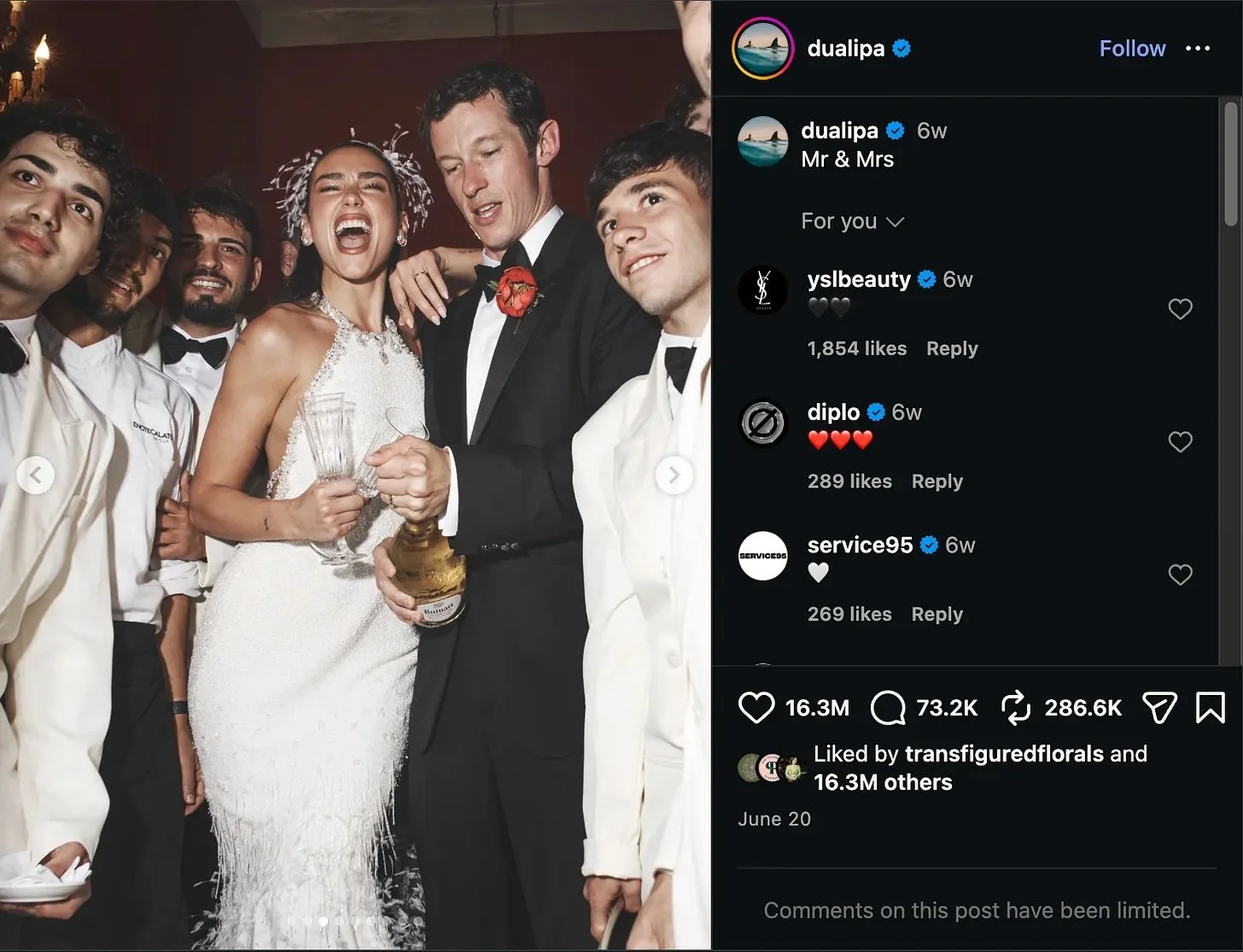
This is what GOOD wedding photography looks like to Gen Z, anno domini 2026
9. You may be competing much earlier than you think
When businesses think about competitors, they usually think about other businesses selling roughly the same thing.
A Pilates studio looks at other Pilates studios.
A wedding venue looks at other wedding venues.
A therapist looks at other therapists.
A website designer looks at other website designers.
And yes, those competitors matter. But by the time someone is carefully comparing several businesses offering the same solution, they're already pretty far down the funnel. They've made an important decision: “I'm going to solve this problem this way.”
Now they're just deciding who to choose.
But you may be competing long before they get there.
Before they choose a provider, they have to choose a solution
If someone has a problem, hiring you is rarely their only possible response to it…They might solve it themselves or use a cheaper substitute. They might spend the money somewhere else or choose an entirely different type of solution. They might postpone the decision.
Or they might simply: do nothing.
And doing nothing is a surprisingly formidable competitor. It's free. It's familiar. It requires no research, no difficult decisions, no implementation and no risk of making things worse. No effort whatsoever. No risk taken.
The customer already knows exactly what living with the current problem feels like. So further up the funnel, you're not necessarily competing against another business. You're competing at the level of the decision itself.
Is this problem worth solving?
Is it worth solving now?
What are my options?
Which type of solution makes sense?
Is changing anything worth the money, effort, uncertainty or risk?
Only after enough of those questions have been answered does the competitive set start narrowing.
And then you’re competing against other providers
This is where traditional competitor research becomes much more useful. Once someone has decided they want pilates, or they’re booking a venue, or they want to hire someone to redesign their website, the decision changes.
Now they're comparing providers. And one of those providers may simply be solving that decision better.
I saw this recently while researching competitors for a Pilates studio. I went through their websites as though I were a potential new client trying to book my first class. On some websites, I clicked Book and was redirected somewhere else.
Then I had to figure out which class I was supposed to choose, wait for an external booking system, create an account and navigate an interface that looked almost completely disconnected from the studio I'd just been considering.
Then I tried one of the larger competitors. Choose a class. Book it. Done.
The competitor wasn't necessarily selling better Pilates. It was making choosing them easier.
And the same thing can happen throughout the decision.
A competitor may explain their services better, make pricing easier to understand, answer an objection you leave unanswered. They may show exactly the proof the customer needs and make packages easier to compare. And help a first-time customer understand what to choose.
Or simply make a particular person think: “Oh. This is for someone like me.”
And sometimes their advantage isn't the website at all. It might be reputation, reviews, location, distribution, pricing, brand recognition or years of accumulated search authority. That's why I don't only want to know who your competitors are.
I want to know where the competition is happening.
Are customers deciding whether to solve the problem at all?
Are they choosing between different types of solutions?
Or have they already chosen the solution and are now deciding between you and someone else?
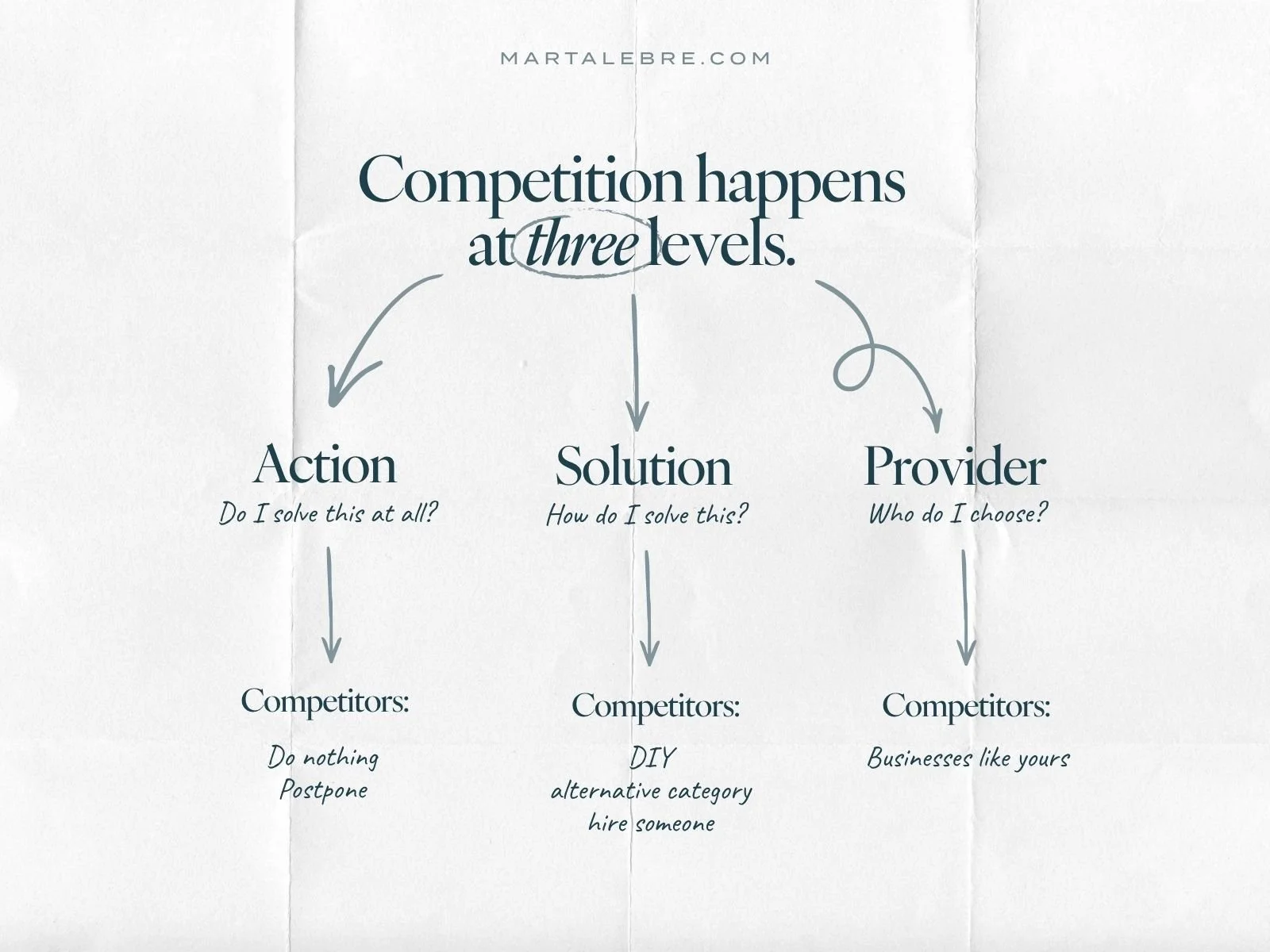
You're not always competing against another provider. Sometimes you're competing against another solution—or doing nothing at all.
10. Your website may be generating leads perfectly well—and your sales process is losing them
This one is particularly fun because I've caught myself doing it.
Someone finds my website. They read enough to decide I might be able to help. They fill out my inquiry form. They tell me about the project.
That is a conversion.
My website has successfully moved a stranger from “Who is this person?” to “I should talk to her.”
And then I can still lose the sale.
I had an inquiry recently where, looking back at the conversation, I realized I may have introduced the price too early—before the potential client had enough context to understand the value of what I was proposing.
Maybe she wasn't the right client anyway.
Maybe the budget was never there.
Maybe she chose someone else.
I don't actually know. But that's precisely the point.
If I responded to that lost opportunity by changing my homepage, I'd be fixing a part of the system that had already done its job. The interesting question isn't: Why didn't my website convert her? Because technically, it did.
The interesting question is: What happened after it converted her?
And I see businesses collapse these two problems all the time. Someone visits your website and they like what they see, so they inquire. And then they disappear.
At that point, please stop blaming the homepage 😂
Now I want to know:
How quickly did you respond?
What did you say?
Did you establish enough value before discussing price?
Was the next step obvious?
Did you ask enough questions before proposing a solution?
Did they book the call?
Where did they hesitate?
What objections appeared?
Did your proposal answer those objections?
Did you follow up?
Did they choose someone else?
And if they did: Why?
There's an enormous difference between “visitors aren't inquiring” and “inquiries aren't becoming customers”. The first might lead me back to your website. The second sends me further down the funnel.
Because a website can generate perfectly qualified leads all day long while a slow response, confusing sales process, badly timed price, poor qualification or weak proposal quietly kills them afterward.
And yes, apparently I have to investigate my own rabbit holes too 😂
11. And yes, sometimes your website really is the problem
After spending this entire article defending websites, I should probably admit something. Sometimes the website is absolutely the problem.
I've seen this repeatedly while researching wedding venue websites (and I audited over a hundred of those).
The venue itself can be spectacular. People are actively looking for wedding venues. They're finding the website. They're within the right geographic market. They like what they see.
And then the website gives them almost nothing they need to decide whether this venue belongs on their shortlist.
Just a beautiful hero photograph, a typical venue copy fluff about timeless celebrations, some pictures of happy couples without any other context and “unforgettable moments” everywhere.
Lovely.
Can I have 150 guests? No idea.
What happens if it rains? No idea.
Is there accommodation nearby? No idea.
What's included? No idea.
Can we hold the ceremony and reception in different spaces? No idea.
What does this roughly cost? Absolutely no idea.
The website has created desire and then abandoned the customer halfway through the decision.
I've looked at venue sites where, after several minutes of clicking around, I still couldn't answer basic questions a couple would need answered before putting the venue on their shortlist.
And in that situation?
Yes.
We have a website problem.
The traffic isn't necessarily wrong, the market doesn't need educating about what a wedding venue is, the couple doesn't need convincing that they want to get married somewhere beautiful. The venue itself may be perfectly competitive.
The website is simply failing to translate that product into the information, confidence and next steps the customer needs.
Sometimes the problem is messaging.
Sometimes important information is buried.
Sometimes the navigation reflects how the venue thinks about itself rather than how couples make decisions.
Sometimes the photographs are beautiful but answer none of the practical questions.
Sometimes the mobile experience makes basic information painful to find.
Sometimes the inquiry process asks for far too much commitment, far too early.
Sometimes the website positions an expensive business like a cheap one.
Sometimes you genuinely do need a redesign.
Great.
Now we have a reason to redesign it.
Which is completely different from “Business is slow, so maybe we need a new website.”
If the evidence tells me that qualified potential customers are arriving with real purchase intent and the website is making it harder for them to evaluate, trust or choose the business, I'm very happy to blame the website.
I am a website designer, after all 😂
I just want the website to be convicted on evidence first.
So what should you change first?
By this point, you may have noticed something slightly inconvenient. Every business in these examples had roughly the same complaint: “I’m not getting enough clients.”
But the correct response was completely different.
The therapist didn't necessarily need more traffic. He needed to understand what kind of traffic he already had.
The garden business couldn't simply capture more existing search demand. First, people had to discover that this kind of solution existed.
The Pilates studio didn't need to copy its competitors' websites. We needed to understand what competitors were making easier for customers.
The wedding venues didn't necessarily need more desire. Couples already wanted beautiful venues. Their websites needed to help them make a complicated decision with more certainty.
And when my own website generated an inquiry but the sale disappeared afterward, redesigning my homepage would have been particularly stupid.
Same symptom, but completely different problems. Which is why I'm very suspicious of advice that starts with the solution. You need more SEO. You need better copy. You need a redesign. You need to post more on Instagram. You need Google Ads. You need a better offer…
Maybe.
But first: Where are people actually disappearing?
If qualified potential customers aren't reaching your website, investigate visibility and acquisition.
If people are reaching it but they're the wrong people, investigate targeting and traffic quality.
If the right people arrive but don't understand why they should care, investigate positioning and messaging.
If they understand it but don't particularly want it, investigate demand, perceived value and the offer.
If they want it but hesitate, investigate trust, uncertainty and risk.
If they inquire but don't buy, follow them past the website and investigate the sales process.
And if something that worked beautifully three years ago suddenly stopped working?
Zoom out and look at the market. Look at competitors. Look at what customers want now and what they consider valuable. What alternatives appeared while you were busy running your business. And then decide what deserves fixing, because otherwise you can spend $5,000 redesigning a website that needed better traffic, spend six months doing SEO for a product nobody knows to search for, or double your ad budget and send twice as many wrong people to an offer they don't want. Or rewrite perfectly good copy when your sales process is losing qualified inquiries. Or keep optimizing conversion on a website whose real problem is that nobody sees it.
All of those things can look like action.
None of them are useful if you're solving the wrong problem.
The first job isn't fixing the problem.
It's identifying the right problem.
Conversion isn’t about changing a button from blue to yellow
When people hear website conversion optimization, they often imagine A/B tests, like: Change the button from blue to yellow. Move the form higher up the page. Try a different headline. Make the CTA bigger… and see whether version B converts 7% better.
There is absolutely a place for that, but it's usually much further down the rabbit hole. And please don't put a giant bright yellow button on your beautiful premium wedding venue website just because somebody's A/B test said yellow buttons get more clicks. 😂
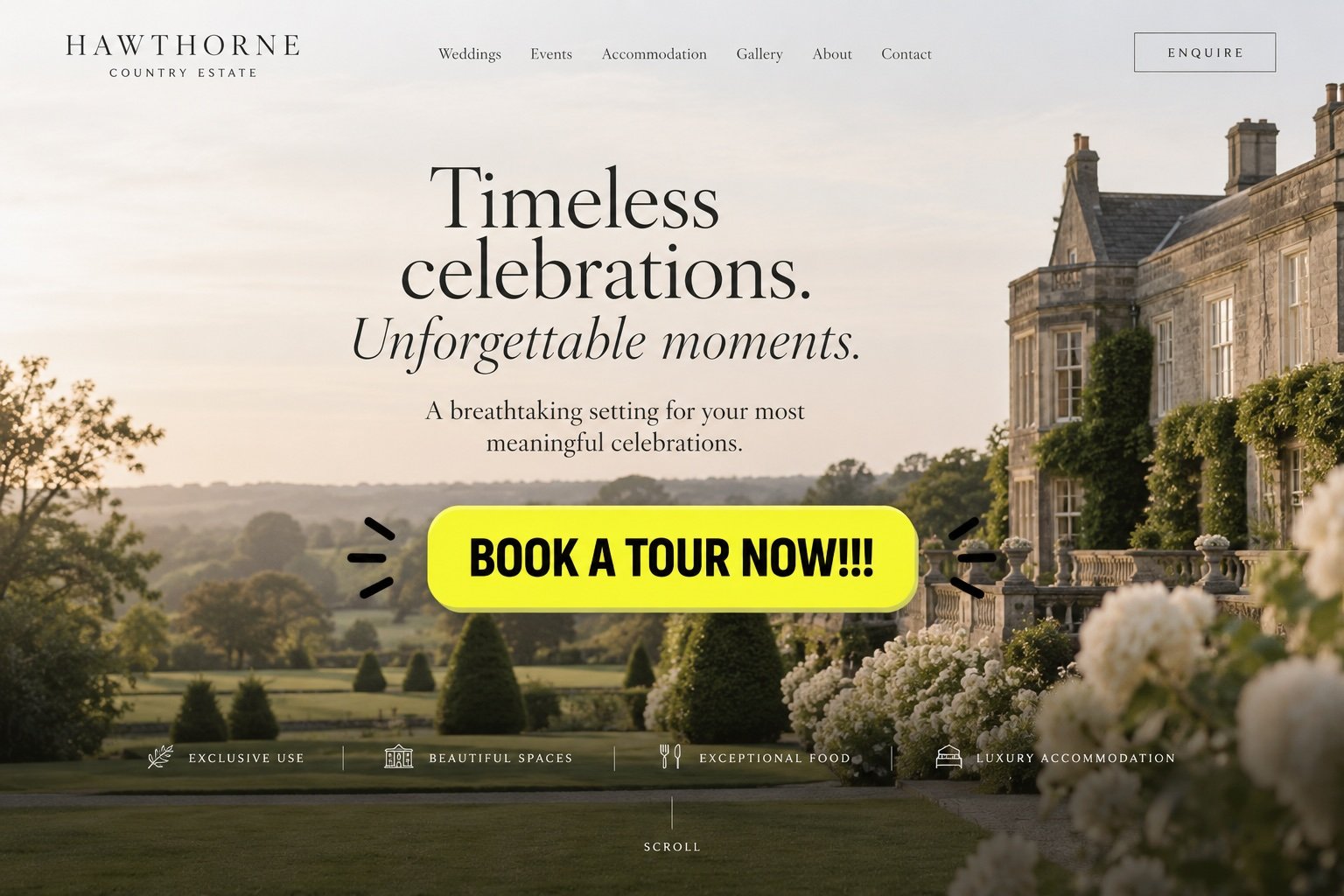
Conversion doesn't happen in isolation from perception.
If that button makes your $15,000 wedding venue suddenly feel like a discount car dealership, we may have increased its visibility while damaging something considerably more important.
The companies obsessively A/B testing tiny changes to landing pages have often already solved most of the bigger problems: they know exactly where their customers come from and what they want. They have a proven offer people buy. They understand the objections and have built enough trust. And they have enough traffic (usually paid traffic of highly targeted audience) for small differences to actually mean something.
Then it makes sense to ask whether changing a button increases conversions by another 4%.
Most small businesses I investigate aren't there yet.
If someone doesn't understand what you sell, the button color isn't the problem.
If they don't particularly want it, the button color isn't the problem.
If they want it but don't trust you with $10,000, the button color isn't the problem.
If they're comparing you with three competitors and can't work out why they should choose you, the button color isn't the problem.
If they click the button, inquire, and then disappear during your sales process...
I have excellent news for the button.
It has been acquitted.
Conversion happens across the entire customer journey which looks like this: Someone discovers you. They decide whether you're relevant. They try to understand what you do. They decide whether they want it. They compare you with alternatives. They look for reasons to trust you. They calculate the risk. They look for answers to the questions making them hesitate. And eventually, they decide whether taking the next step feels worth it.
And even after they click Inquire, the conversion journey isn't necessarily over.
That's why I don't particularly care whether your website has a 0.8% or 2.4% conversion rate until I understand who those visitors are, what they came looking for, what they're being asked to buy and what happens to them along the way.
A conversion rate tells me what happened.
It doesn't automatically tell me why.
And the why is where the useful stuff is.
The discrepancy is usually where things get interesting
After enough of these investigations, I've learned to pay attention when two things don't seem to make sense together.
You have traffic, but nobody inquires.
People constantly tell you how beautiful your work is, but they don't buy it.
You rank on Google, but you're not getting clients from search.
People inquire, but they disappear before buying.
One service sells beautifully, another one doesn't.
Your business used to generate clients consistently, now it doesn't—and you haven't changed anything.
Those contradictions aren't annoying details to explain away. They're clues. And that's usually where I start digging.
Because if people love the product but don't buy it, I want to know what happens between admiration and desire. If you're getting traffic but no inquiries, I want to know who those visitors actually are. If people inquire but don't become customers, I want to follow them past the website. If something worked for five years and suddenly stopped, I want to know what changed around the business.
I don't want to make the evidence fit my preferred solution.
I want to follow the evidence until the problem makes sense.
That's the rabbit hole.
This is why I created the Rabbit Hole Investigation
Some business problems don't need another website audit. They need a detective.
The Rabbit Hole Investigation is for those frustrating situations where something isn't working—and you don't actually know why.
Instead of choosing a solution first, I investigate the business until I can give you an evidence-based explanation of what's most likely going wrong, why, and what I think you should do about it.
Where that takes me depends entirely on what I find.
Sometimes it's the website. Sometimes it's SEO, traffic, positioning, the offer, competitors, the market or what happens after someone inquires.
And sometimes it's something neither of us expected.
The outcome isn't a list of website best practices.
It's knowing what problem is actually worth solving before you spend money solving it.

Frequently Asked Questions
-
A website can fail to generate leads for many reasons, and the website itself is only one of them. You may have too little visibility, attract the wrong traffic, have unclear positioning, lack sufficient trust, have an offer customers don't want enough, or lose potential customers later in the sales process. Start by identifying where people disappear before deciding what to change.
-
If your website gets traffic but few inquiries, first determine whether those visitors are actually potential customers. High traffic from informational searches, irrelevant locations or people outside your target market can make a website appear popular without creating meaningful sales opportunities. If the traffic is qualified, investigate positioning, messaging, trust, your offer and conversion friction next.
-
A traffic problem means too few of the right people are reaching your website. A conversion problem means qualified potential customers are reaching it but aren't taking the desired action. They require different solutions. More SEO traffic won't necessarily solve a conversion problem, and conversion optimization can't help customers who never discover you.
-
Look at the customer journey in sequence. Are potential customers finding you? Are the right people reaching your site? Do they understand the offer? Do they show signs of wanting it? Do they trust you enough to inquire? And once they inquire, do they become customers? Finding where the journey breaks helps distinguish a website problem from a visibility, targeting, offer, market or sales problem.
-
Not necessarily. A website redesign can help when the website itself is creating confusion, attracting the wrong audience, undermining trust or making it difficult to take action. But if the underlying problem is visibility, targeting, demand, positioning, your offer or your sales process, redesigning the website may simply give you a nicer-looking version of the same problem.
-
If qualified people are already submitting your contact form, the website has successfully completed an important part of its job. Investigate what happens after the inquiry: response time, qualification, pricing, sales calls, follow-up, proposals, objections and whether the expectations created by your marketing match the offer they're eventually given.
-
Yes. A well-designed website can accurately communicate a strong business and still produce little business if too few potential customers find it, the wrong audience visits it, market demand is weak, competitors have stronger advantages or the sales process loses leads after they inquire. Website performance needs to be evaluated as part of the wider customer-acquisition system.