Updated November 2026
A couple can scroll through every photo on your website, fall a little in love with the ceremony lawn, and still have no idea whether they can afford it. At that point they have two options. They can send an inquiry and wait, or they can open the next venue's website. And overwhelmed Gen Z couples are not the most patient, so guess what they would rather do.
So yes, wedding venues should show pricing on their website. Not necessarily every package and fee, but enough for a couple to know whether you're in their range before they inquire. A missing price isn't neutral because the couple fills the gap themselves, and rarely in your favor.
The short answer
Show a starting price and a typical total, and say what changes it: day of the week, season, guest count.
Say what's included, because "$8,000" means one thing with tables, chairs and a coordinator, and another without.
Put it on a page, not only inside a PDF brochure.
Keep it consistent with The Knot, WeddingWire and anywhere else your venue is listed.
Keep the full quote for the conversation. Starting prices filter. Quotes close.
What couples say about pricing
The most useful numbers come from The Knot's own research with couples. The Knot sells listings to venues and encourages vendors to publish pricing, so it isn't a neutral party, but the figures point the same way as everything else I've seen.
In The Knot's 2024 Couples Finance and Budgeting Study (700+ couples):
80% said pricing is the first thing they look for when researching vendors.
70% said vendor pricing transparency is very influential when it comes to booking.
50% had stopped communicating with a vendor once they found out the price was out of their budget.
That last figure is the one I'd think about. Half of couples had inquired, waited, read a quote, and disappeared. On your side, that's an inquiry someone answered, a brochure someone sent, maybe a tour someone ran on a Saturday morning, all for a couple who were never going to book.
Venues are also the biggest line in most wedding budgets. In The Knot's 2024 venue report, the venue took nearly 40% of a couple's budget on average. And according to WeddingPro's 2024 vendor study, around 60% of wedding vendors already show pricing. If the venue next door is in that 60% and you aren't, a couple comparing you can rule them in and can only guess about you.
Why a missing price costs more than it seems
Surveys tell you what couples say. Behavioral research explains what happens in their heads when the price isn't there.
The couple fills in the blank. Daniel Kahneman calls it WYSIATI, "what you see is all there is". The fast, intuitive part of the mind builds the most coherent story it can from whatever is in front of it, and doesn't stop to ask what's missing. On a venue website with no pricing, the quickest story is "probably out of our range". The couple never consciously decides you're too expensive. They just quietly stop considering you.
Not knowing is worse than the number. Rory Sutherland's favorite example is the Uber map. It didn't make cars arrive any faster. It made the wait far less stressful, because people mind uncertainty more than the wait itself. "Inquire for pricing" is a wait with no departure board. Steve Krug, writing about websites specifically, lists hiding prices among the quickest ways to drain a visitor's goodwill, because it looks like the old sales move of getting people invested before the sticker shock.
If you don't set the anchor, someone else will. Kahneman reports a study in which experienced real estate agents were swayed by an arbitrary listing price (an anchoring effect of about 41%) while insisting it hadn't influenced them. Dan Ariely shows that the first price someone seriously considers in a category becomes the peg they judge everything else against. If your website says nothing, that peg comes from a cheaper venue down the road, a national average on a wedding-planning site, or a friend's wedding three years ago. You then spend the sales call arguing with someone else's number.
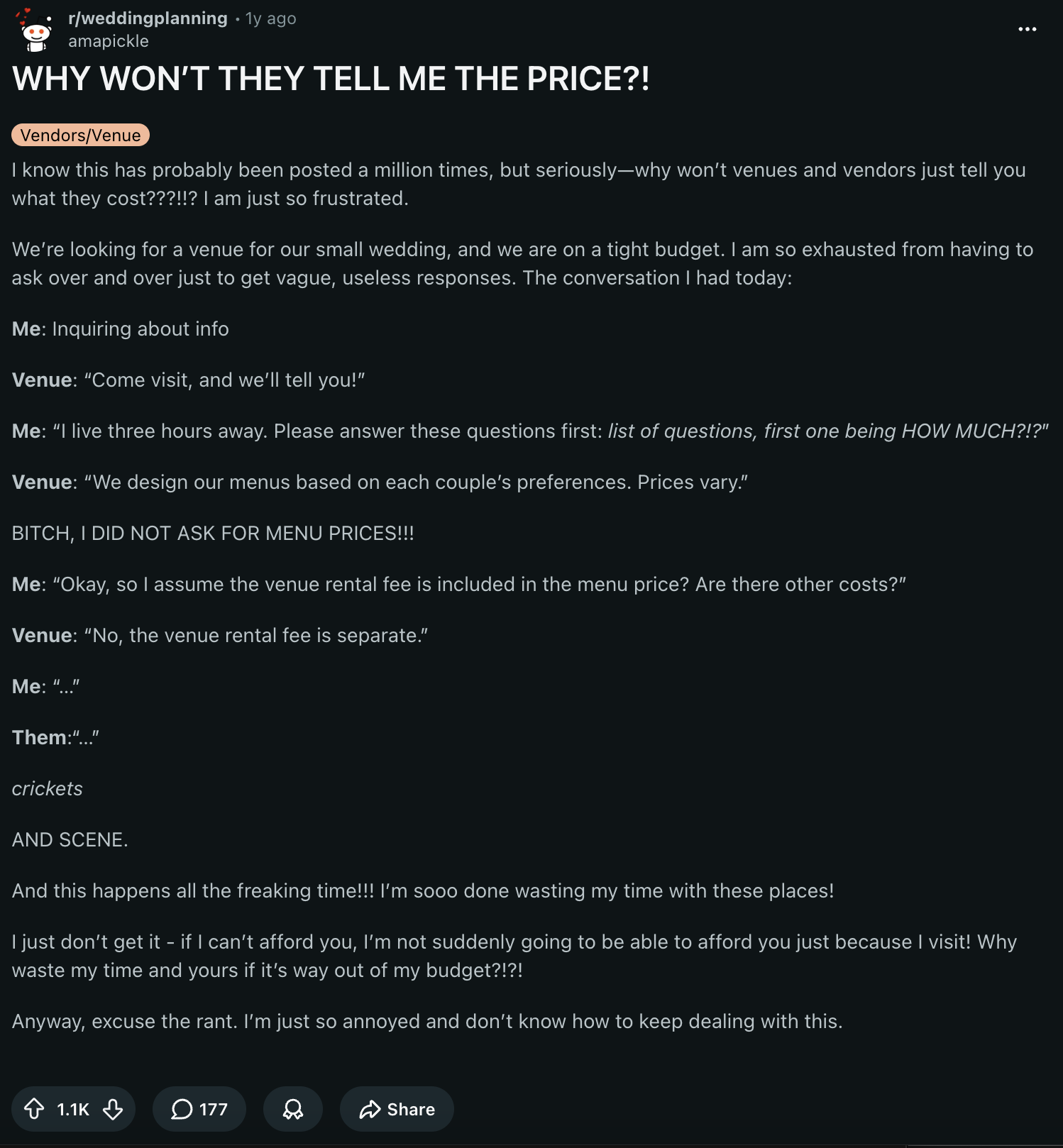
Why venues hide their prices (and what to do about it)
The reasons venues give are mostly fair. They just don't justify showing nothing.
“Our pricing depends on too many things.”
It does. A Friday in March for 60 guests and a Saturday in June for 180 are different events. That's an argument for a starting price plus what changes it, not for silence. Couples understand that a Saturday in June costs more. What they can't do is guess by how much.
“Competitors will undercut us.”
They can already find your prices. Couples share quotes in Facebook groups and Reddit threads, and sites like Tulle Together collect venue pricing PDFs uploaded by couples. Hiding prices on your website mostly hides them from the couples who haven't inquired yet.
“We want to talk to couples before they see a number.”
Understandable, especially if your venue is worth more than it looks in photos. But the couples most likely to assume the worst are the ones who could have afforded you, and the conversation you want doesn't happen if they've already left. If they'd get sticker shock from a price on your website, they'd also get it from the quote you send after the brochure, the follow-up and the tour.
Three ways to show pricing on your venue website
| Approach | What couples see | Works best for | Trade-off |
|---|---|---|---|
| Full packages | Named packages with prices and inclusions | All-inclusive venues and venues with set packages | Least flexible. You'll update it every season |
| Starting price + what changes it | "Saturdays from $9,500 for up to 120 guests," plus how day, season and guest count affect it | Most venues | Couples still need a quote, which is fine |
| Typical range | "Most couples spend $14,000–$22,000 with us, including catering" | Venues with complex, custom pricing | Less precise, but it answers "can we afford this?" |
For most venues I'd combine the last two: “Saturdays from $9,500. Most couples spend $14,000–$18,000 for around 120 guests, including catering.” A starting price on its own anchors, but if it's deliberately low, it just moves the sticker shock to the quote. The typical total sets an honest anchor and lets a couple see themselves in it, without committing you to a fixed number.
How to present your prices
How you show a price changes how it feels. Four principles hold up well for venues.
Offer three packages, and put the one you'd recommend in the middle. In Ariely's best-known experiment, The Economist offered web-only, print-only and print-plus-web subscriptions, with print-only priced the same as print-plus-web. Nobody chose print-only, but 84% chose the combined deal. When print-only was removed, 68% chose the cheapest option. The packages around the middle one change how it looks. Every package has to be one you'd be happy to sell, though. Couples compare notes, and an obviously fake package costs more trust than it earns.
Show the biggest package first. Robert Cialdini's contrast principle is why clothing shops sell the suit before the sweater: after the suit, the sweater feels small. On a pricing page, lead with the full-weekend buyout, and the Saturday package will look reasonable rather than steep.
Bundle instead of itemizing. Ariely's research on the “pain of paying” explains why one inclusive figure stings less than a long list of add-ons. Sutherland makes the same point about airline baggage fees, which seem fair for one bag and feel like a rip-off for a family of four. Per-item wedding fees feel the same to couples who are already anxious about money.
Name the drawback before they do. Cialdini shows that people who mention a weakness first are seen as more honest, which makes everything they say next more believable. Richard Shotton calls it the pratfall effect, and his examples are Stella Artois's “Reassuringly Expensive” and Avis's “We try harder”. A line like “We're not the least expensive venue in the valley, and here's what that pays for” earns more trust than a page of luxury adjectives. It only works if the experience lives up to the price.
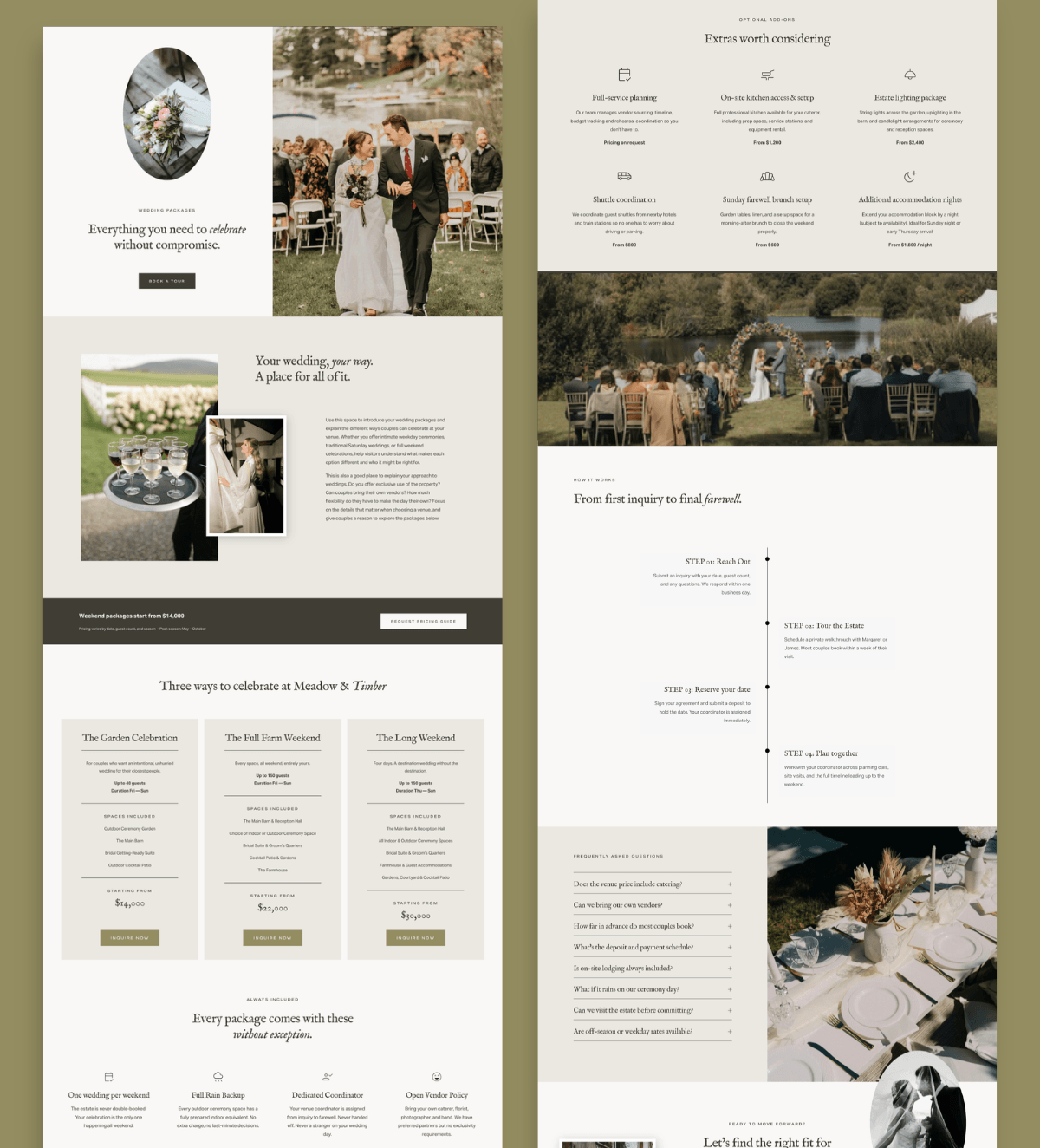
The Pricing page in my Meadow & Timber template: a starting price up front, three packages, a list of what every package includes, priced extras, and the questions couples ask about cost. Prices are demo content
What to put on a wedding venue pricing page
Starting prices by day of the week and season. Label the year (“2027 pricing”). Use round numbers: $9,500 reads as a considered price, $9,499 reads as a sale.
Guest count. What the starting price covers, and how the price changes above it.
What's included. Tables, chairs, linens, setup and breakdown, the coordinator, getting-ready rooms, hours of access. In The Knot's 2024 venue report, 76% of couples said their venue fee included rentals and 44% said it included catering, so couples will compare your inclusions against that.
What isn't included, and any minimums: a food and beverage minimum, required vendors, cleaning, security, insurance.
An example total. “A Saturday in June for 120 guests with our catering usually comes to around $X.” This line does more to help a couple decide than the rest of the page combined.
Deposit and payment schedule.
Off-season and weekday options, if that's where your empty dates are.
A next step: check availability, book a tour, or request the full pricing guide.
Where pricing should live on the site
On its own page, linked from the main navigation as “Pricing” or “Packages & Pricing”. Couples look for those words.
A line on the home page and each space page, such as “Ceremony and reception from $9,500”. Many couples never reach the pricing page.
On the page, not only in a PDF. A PDF is fine as an extra, but couples on phones often won't open it, and AI tools may not read it.
The same everywhere. If your website says $9,500 and your directory listing still says $8,000 from two seasons ago, couples notice, and so do the AI tools that compare sources.
What I keep finding when I audit venue websites
Pricing that only exists inside a PDF brochure
A different price on the website than on The Knot or WeddingWire
“Contact us for pricing” on a site that lists every other detail, including the parking
Pricing pages that give a number but don't say what it includes
None of these is hard to fix, and most venues don't know they're doing them.
Should you ask for an email before showing the full price guide?
It's a reasonable trade if the starting price is already on the page. The couple can tell they're in range before they hand over anything, and the ones who download the full guide are worth following up. Hiding every number behind the form is the version that doesn't work. To the couple it looks like a sales funnel, and the ones who are shopping around will skip it.
Whichever you choose, plan what happens after a couple inquires: a confirmation page, an automatic email with your pricing guide, and a personal reply within hours.
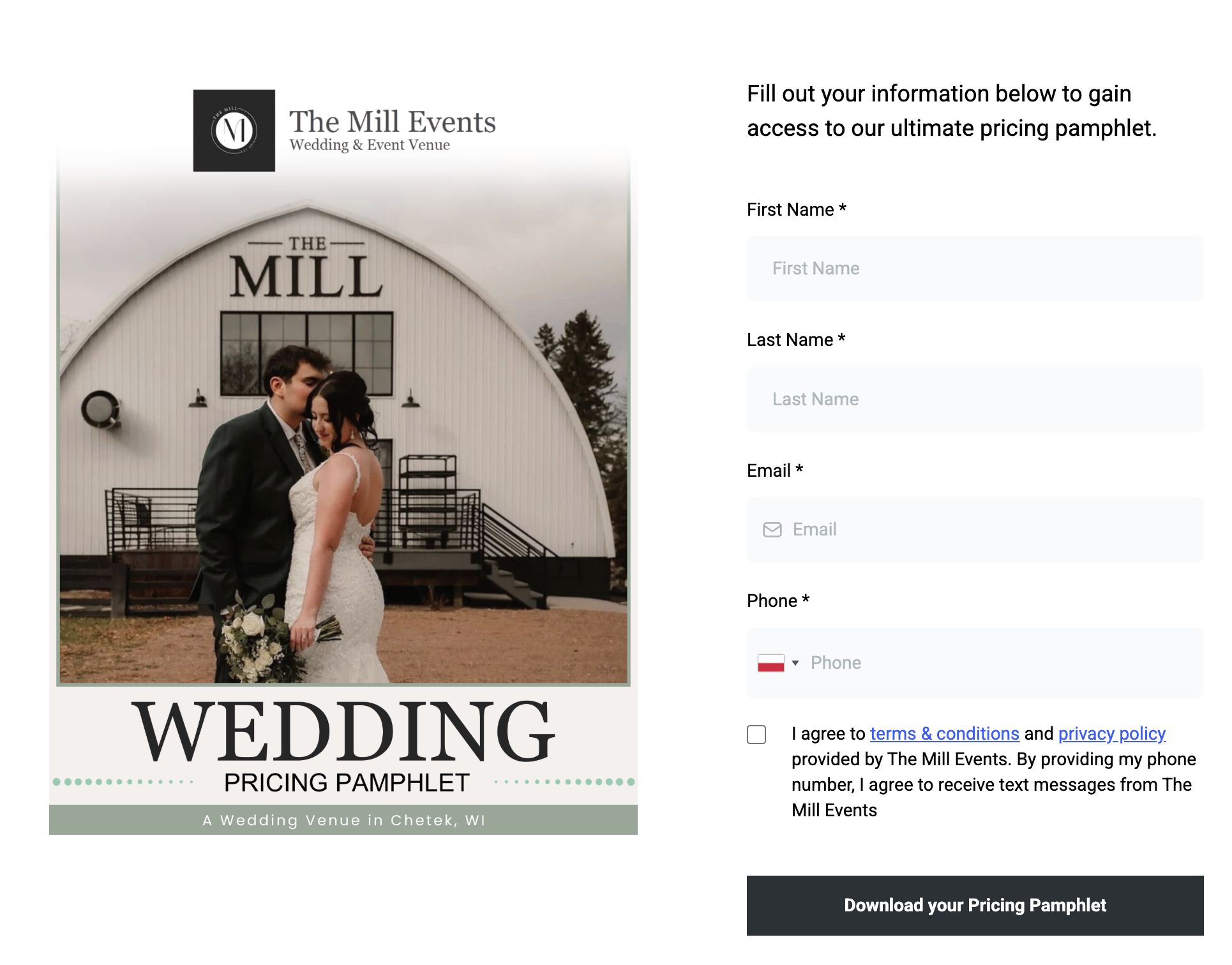
If trading one’s email address is the only way to see the prices, couples are not gonna fall for it.
Pricing, positioning and the couples you actually want
Showing a price can feel risky for a high-end venue, as if a number makes the place look ordinary. It works the other way. Shotton describes experiments in which the same placebo pill relieved more pain when it was labeled as expensive, and the same perfume was rated much more highly at double the price. A venue that states its price calmly is telling couples it believes in what it sells.
A confident starting price tells the right couples they're in the right place and saves everyone else a tour. The couples who inquire after seeing it already know what you cost, so the conversation starts with their wedding instead of your rate card. If you'd rather not show prices at all, your website has to make the venue's value so clear that couples inquire without knowing the cost. Some venues manage that, but it takes very strong photography, specific copy, and a site built around how couples decide. That's much harder than adding a starting price.
Pricing and AI search
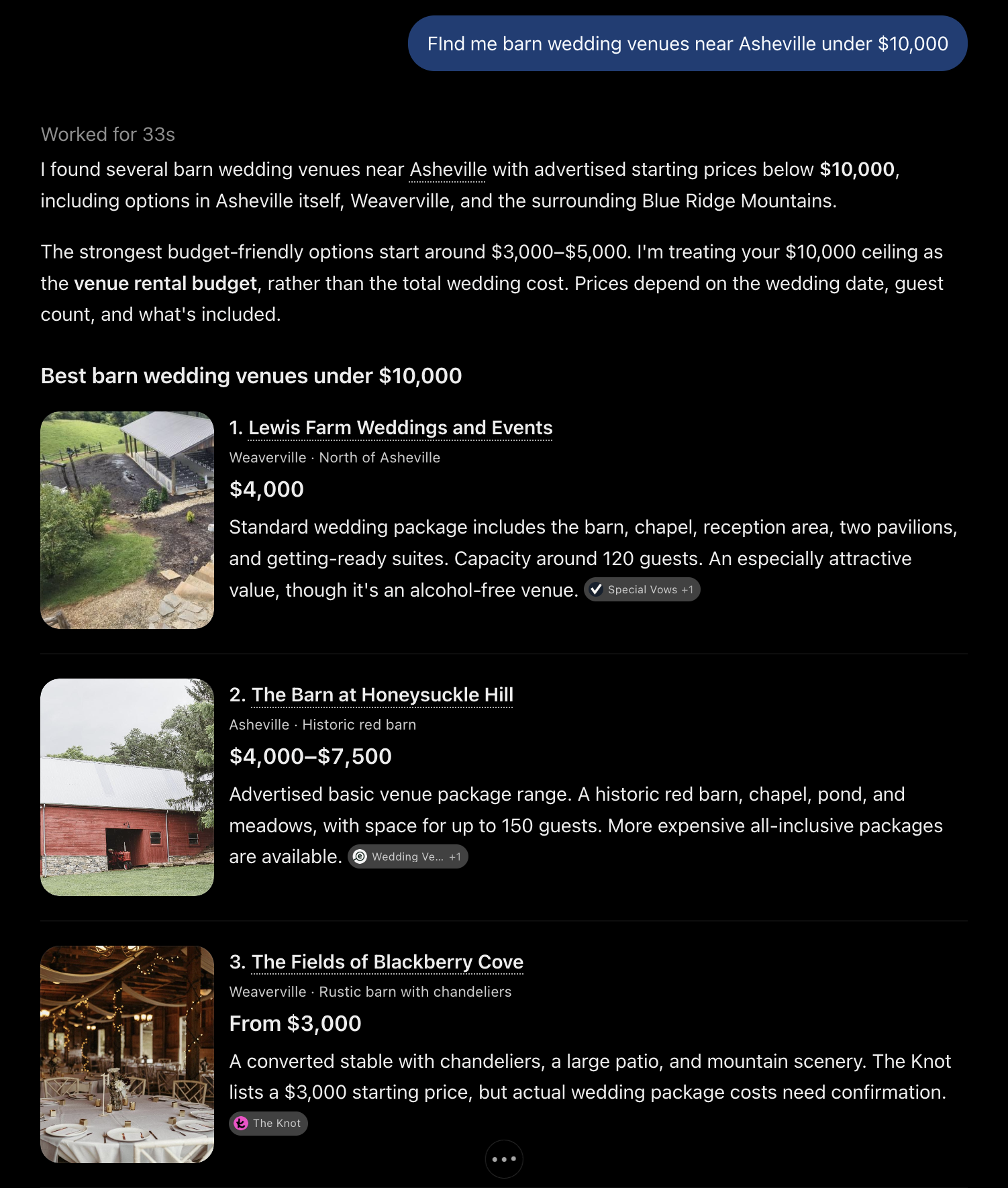
AI tools like ChatGPT, Perplexity and Google's AI Overviews build venue shortlists from whatever they can read. If a couple asks for “barn wedding venues near Asheville under $10,000” and your price is in a PDF, in an image, or nowhere, the tool can't tell whether you belong on that list. It may use whatever figure it finds on a directory instead. More on that in the AI shortlist: why your venue is judged before anyone visits your website.
Frequently Asked Questions
-
Yes, and the figures should match your website. Couples compare venues on those platforms side by side, and a listing without pricing looks incomplete next to one that has it.
-
Some couples will ask about your lowest-priced dates. That's useful, because those are usually the hardest dates to fill. Show what the starting price covers and what a typical Saturday costs, and couples can sort themselves.
-
Only if almost nobody pays it. A starting price based on a Tuesday in January that no one books will annoy couples rather than help them. Put an example total for a typical wedding next to it.
-
At least once a year, when you set next season's rates. Label the page with the year, and update your directory listings the same day.
Building a venue website with pricing that works
If you're building or rebuilding your venue's site, Meadow & Timber, my Squarespace template for wedding venues, comes with a ready-made pricing page (three packages, what every package includes, priced extras and a pricing FAQ) plus a copy guide for the questions couples ask before they inquire. I can also customize it for you from $1,800. If your pricing needs more explaining than a template allows, a custom venue website with strategy ($4,000–$8,000) starts with working out how couples in your area compare venues. That's wedding venue website design.
For the rest of the website, see how to build a wedding venue website and what couples need to see on a venue website.
Sources: The Knot 2024 Couples Finance and Budgeting Study, via WeddingPro (couple figures; vendor pricing share from WeddingPro's 2024 Annual Vendor Study, same page); The Knot Real Weddings 2024 Vendor Report: venues (share of budget, venue fee inclusions).
Books: Daniel Kahneman, Thinking, Fast and Slow (WYSIATI, ch. 7; anchoring and the real estate agents, ch. 11) · Rory Sutherland, Alchemy · Steve Krug, Don't Make Me Think, Revisited (ch. 12, "Usability as Common Courtesy") · Dan Ariely, Predictably Irrational (the Economist subscriptions, ch. 1; arbitrary coherence, ch. 2) · Robert Cialdini, Influence, New and Expanded (contrast, ch. 1) · Richard Shotton, The Choice Factory.