Most people ask this question as if there were two answers. Buy a template and build it yourself, or pay a designer to make something from scratch.
There are three. And the difference between them has less to do with how the website looks than with who does the thinking.
I'm a die-hard DIYer, so I understand the template instinct completely. I've built and rebuilt my own websites, spent evenings adjusting the curve of a button, and convinced myself that one more headline tweak would make me ready to launch. A good template can carry you a long way. It just can't tell you what your website should say, which pages your buyers need, or why they keep leaving without getting in touch.
Here's what each option actually gets you, where each one runs out, and how to tell which one you need.
This post contains an affiliate link. I only recommend tools I use.
The short answer
A Squarespace template ($197–$500) is right if you're happy to build the site yourself, your budget is tight, or you're still testing what you sell.
Template customization (from $1,800) is right if you've found a template you like and know what you want to say, but don't want to spend three weekends fighting the mobile layout.
A custom Squarespace website (from $4,000) is right if your website has to persuade people to make a considered decision, and you're not sure the current structure, messaging or pages are doing that.
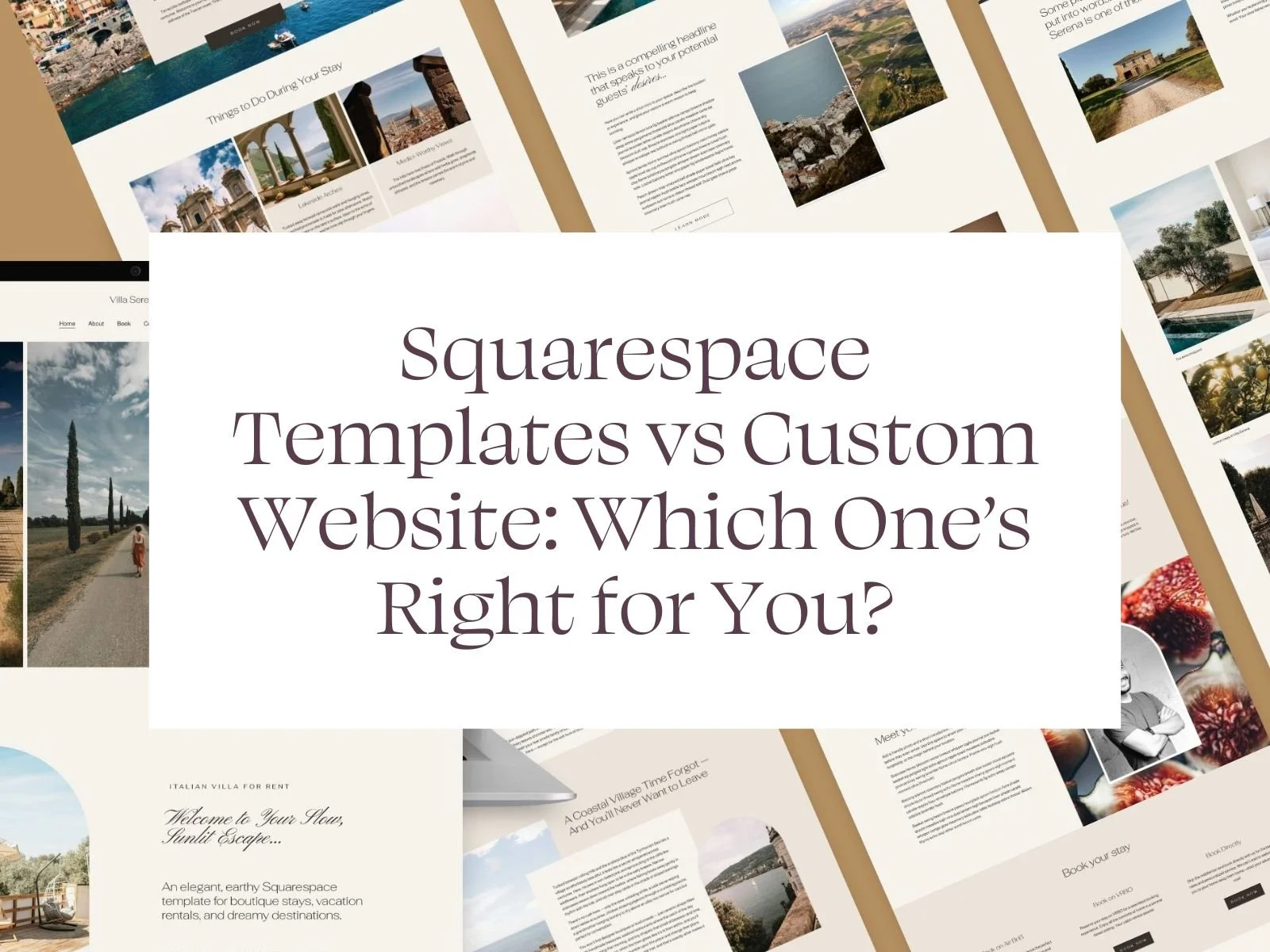
What a Squarespace template gets you
A template is a finished design built for an imaginary business that looks a bit like yours. You get the pages, the layout, the fonts and the colour palette, plus somebody else's photos and placeholder copy. You swap in your own content and adjust the styling.
On Squarespace 7.1, every template shares the same underlying features, so you're not locked into anything technically. With Fluid Engine you can move, resize and restyle almost anything. That's the good news, and also the trap: you can change everything, so the template stops being a shortcut the moment you start.
A premium template is worth buying when:
You enjoy the process and have the time for it.
You want to launch quickly and improve as you go.
You're not ready to spend thousands before you've tested your offer.
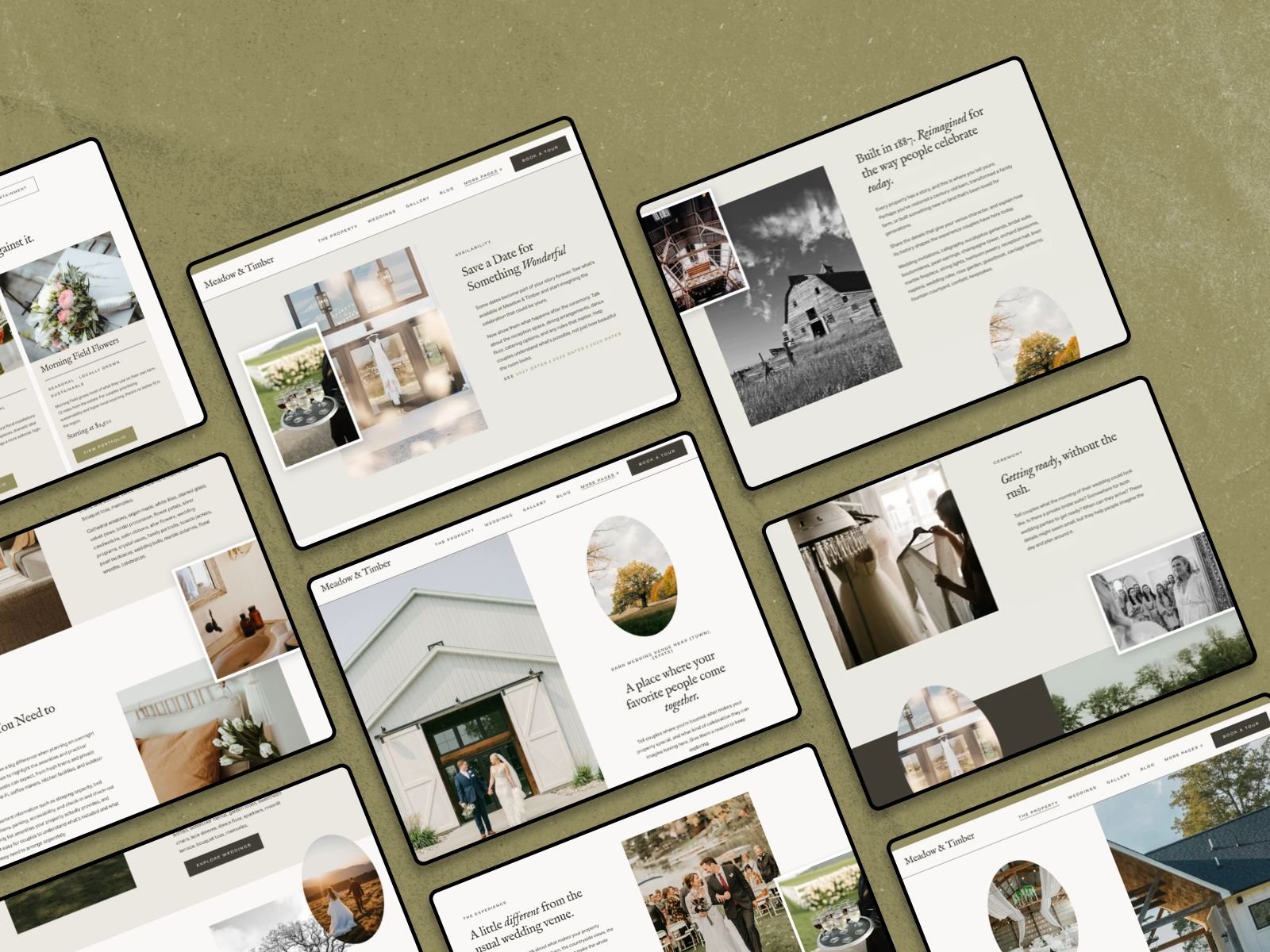
Designer templates also usually come with more thought built in than free ones: page structures based on a specific type of business, copy prompts, and SEO-friendly headings. Mine are built around how a particular buyer decides. Meadow & Timber, a Squarespace template for wedding venues, includes a venue copy guide covering the questions couples ask before they enquire. Aurora is for therapists and private practices, and Tide is for short-term rentals that want direct bookings. You can browse all my Squarespace templates if none of those fits.
If you want to push a template further on your own, Spark Plugin adds design options Squarespace doesn't have by default. Code MARTALEBRE gives you 10% off.
For venues, I've written a separate guide to building a wedding venue website that compares a DIY template, a customized template and a custom site, with prices.
What a template can’t do
None of these limits is technical. They're about what a template was never designed to know.
It doesn't know your buyers. A template's pages and their order reflect the designer's best guess about a typical business in your category. If your clients need to understand something unusual before they commit, like a specific process, a price range or a reason to trust you over the next option, the template has no section for it. You'll either cram it into a block made for something else or leave it out.
It can't write your website. The placeholder copy is there to make the demo look finished. Replacing it with your own words is the hardest part of the build, and it's also the part that decides whether anyone gets in touch.
It looks like other websites. Popular templates are popular. Change the colors and photos and most visitors won't notice, but someone comparing three businesses in the same niche might.
Its SEO is only as good as what you put in. A well-built template gives you sensible headings and clean structure. It can't research what your buyers search for, decide which pages you need to rank for it, or write the content that answers those searches.
It won't tell you when it's the wrong structure. This is the one that costs the most time. A template built for a coach can be bent into a website for a wedding venue, but you'll spend weeks discovering where it doesn't fit.
Template customization: the option in between
This is the option most comparisons skip, and it's often the one people actually need.
With Squarespace template customization, you bring a template you like (one of mine, another designer's, or a free one from Squarespace) along with your branding and content. I turn it into a finished, launch-ready website. That covers fonts, colors, logo and button styles; adding and formatting your copy; replacing and optimizing images; mobile layouts; custom CSS where needed; basic on-page SEO; forms, analytics and launch setup.
Most customization projects take one to two weeks. Prices start at $1,800.
The important part is what customization doesn't include: it keeps the template's structure. No research or strategy goes into deciding which pages you need or what they should say, and there's no keyword research. If halfway through we find ourselves rebuilding the architecture and rethinking the message, we've stopped customizing a template. At that point you need a custom website, and I'll tell you so.
Template customization is a good fit if:
You already have a template you like, and its structure makes sense for your business.
You know what you sell and who you're selling it to.
Your branding and content are ready.
You mainly need someone who knows Squarespace to put it together properly.
What a custom Squarespace website is
A custom website starts with the questions a template skips. Who is choosing between you and the alternatives? What do they need to understand, see or believe before they get in touch? What are they searching for? Only once those are answered do we decide which pages the site needs and what goes on them.
With custom Squarespace website design, the strategy comes first: market and competitor research, keyword research, positioning and site architecture. Then comes design and build in Squarespace 7.1, with SEO built into the structure (metadata, schema, URL structure and search setup). The project ends with testing, tutorials and 30 days of support after launch. Most projects take four to six weeks. Prices start at $4,000.
You still end up with a Squarespace site you can edit yourself, without calling a developer every time a price changes.
Custom design is not the same as custom code
If you've been reading other comparisons, you've probably noticed that "custom website" means two different things. Development agencies use it for a site coded from scratch, and they compare that with Squarespace as a whole. A custom Squarespace website is something else: the design, structure and content are made for your business, but it's built on Squarespace, so you keep the editor, the hosting and the ability to change things yourself.
For most service businesses, venues included, hand-coded is more than they need and harder to maintain. You don't need a bespoke engine to explain your ceremony spaces. You need the right pages saying the right things.
If you already have a Squarespace site that has stopped working for you, a website redesign is the same kind of thinking applied to what you've got.
Squarespace template vs Custom website: side by side comparison
| DIY template | Template customization | Custom Squarespace website | |
|---|---|---|---|
| Cost | $197–$500 one-time | From $1,800 | From $4,000 |
| Who builds it | You | Me, on your chosen template | Me, from scratch |
| Timeline | As long as your evenings allow | 1–2 weeks | 4–6 weeks |
| Structure and pages | The template's | The template's, refined for your content | Planned around how your buyers decide |
| Copy and messaging | Yours | Yours, formatted and placed | Shaped by research before design |
| SEO | What you set up | Basic on-page SEO | Keyword research, site structure, schema |
| Best for | Testing an offer, tight budget, enjoying the build | A clear business that needs a polished site fast | An established business whose website has to persuade |
If you're comparing quotes, here's a fuller breakdown of what Squarespace designers charge at different price points, and what changes between them.
How to choose
Skip the question of which option is "better". Ask these instead.
How much does your website have to persuade? If people find you through referrals and only check the site to confirm you're real, a template usually does the job. If strangers compare you against three alternatives before deciding to spend real money, the website is doing sales work, and structure matters much more.
How clear is your offer? If you can explain what you sell, to whom and for how much in two sentences, a template or customization will work. If you keep rewriting your services page because it never sounds right, the problem isn't the design.
What's your time worth right now? A template saves money and costs hours. Be honest about whether those hours exist, and whether they'd be better spent on the work that pays you.
Does the template's structure fit your business? Put your content next to the demo. If it fits, customize. If you're already inventing workarounds, go custom.
What's your budget, really? Prices are clear here. Spending $4,000 before your offer works is a poor use of $4,000. Spending three months fighting a $200 template while enquiries go elsewhere isn't cheap either.
If you run a wedding venue…
Venues are a good example of where the middle option earns its keep. Couples arrive with the same questions every time: capacity, ceremony and reception spaces, accommodation, catering rules, what a date in June actually costs. A template built for venues already has a place for those answers.
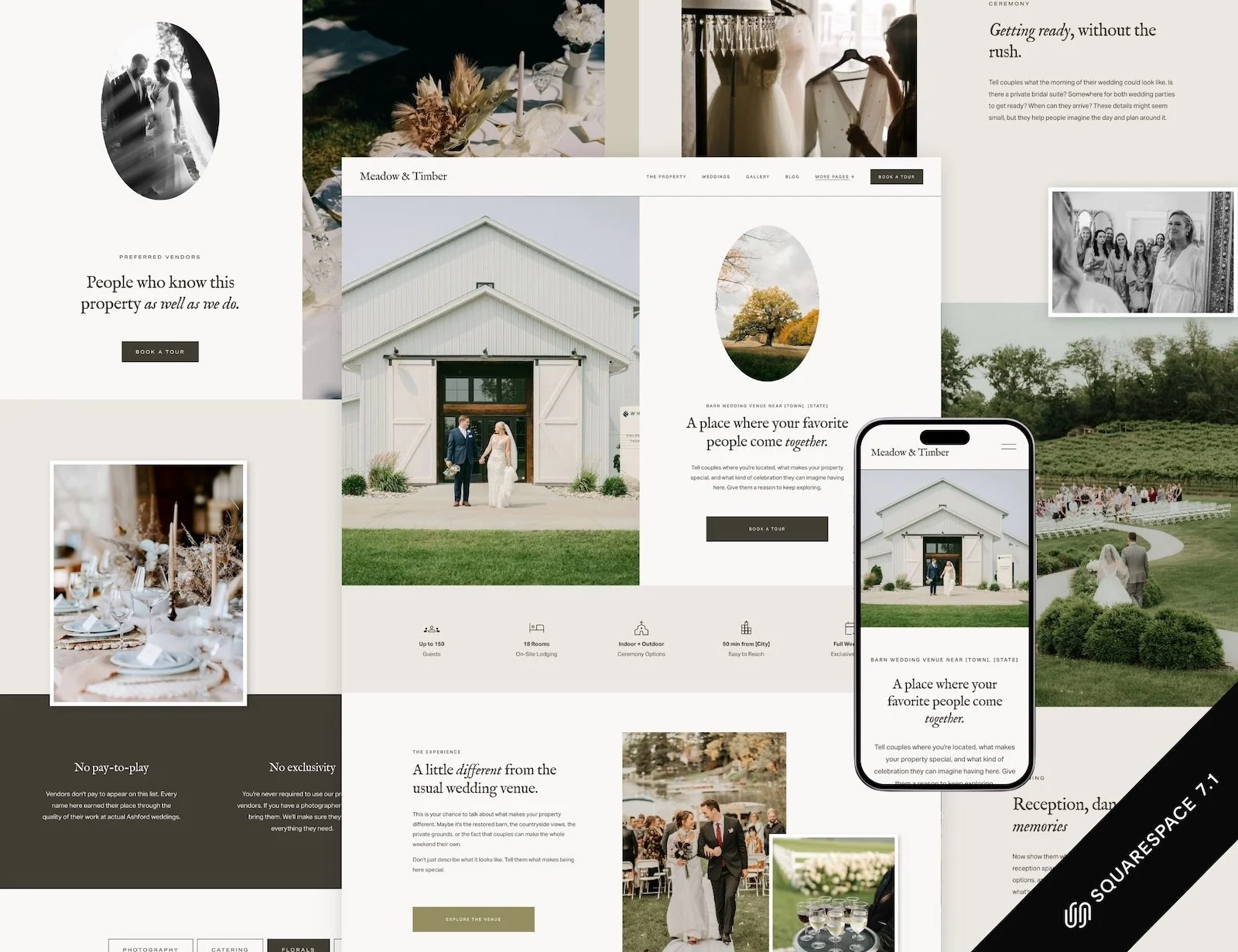
Meadow & Timber was designed for exactly that. Plenty of venues can build it themselves. If you'd rather not, template customization turns it into your venue's site with your photos, packages and details. When you need more than that (several event spaces, a property that's hard to explain, or a site that has to compete in a crowded local market), have a look at my wedding venue website design work. If you're still working out what the site needs to say, start with what couples need to see on a venue website.
Wedding planners and photographers sell something more personal, and I don't currently have templates built for them. For those businesses I'd usually recommend custom design.
Can you start with a template and go custom later?
Yes, and for a lot of businesses it's the sensible order. Your first website should be a minimum viable website: enough to explain what you do, look credible and let people get in touch. You don't yet know which questions clients will ask, which services will sell, or which pages anyone will read. A template gets you online while you find out.
Some of my custom clients started exactly like that. They built a first site on a template (sometimes mine, often someone else's), won clients with it, and came back once the business had grown past it. By then they knew what their buyers needed to hear, which made the custom project better. The template did its job for that stage.
And if you're moving from one design to another on a site that already ranks, read how to redesign your Squarespace site without starting over first.
FAQs
Can a Squarespace template look custom? Yes. Change the fonts, colors, photography and a few layouts and most visitors won't recognize the template. What changing those can't do is fix a structure that doesn't fit your business. A template can be made to look custom. Only a custom site is planned around your buyers.
What's the difference between template customization and custom website design? Template customization keeps the template's structure and fills it with your branding and content. Custom design decides the structure first, based on research into your buyers, competitors and search demand. They're different services, not the same one at two price points.
How much does a Squarespace website cost? On top of your Squarespace subscription, a premium template costs $197–$500 if you build it yourself. Having a designer customize a template starts at $1,800 with me. A custom Squarespace website starts at $4,000. The designer pricing guide covers what changes between those price points.
What's the downside of Squarespace? You work within its blocks and features. For a service business or a venue that's rarely a problem. If you need complex booking logic, a large catalogue or deep integrations, check that the tools you rely on connect to Squarespace before you commit.
How long does each option take? A DIY template takes as long as you give it. Template customization usually takes one to two weeks. A custom Squarespace website usually takes four to six weeks, depending on scope, content and feedback.
Is a custom website better for SEO than a template? Not automatically. Google doesn't rank custom designs above templates. What helps is doing keyword research before deciding which pages exist and what they say. Custom projects include that. Templates and customization projects include basic on-page SEO but not the research.
Can you customize a template I bought from another designer? Yes, as long as it's a Squarespace 7.1 template. That includes free Squarespace templates.
Will I be able to edit the site myself afterwards? Yes, with all three options. That's one of the main reasons to build on Squarespace in the first place.
Where to go from here
If you want to build it yourself, browse my premium Squarespace templates.
If you've found a template you love and want someone else to finish it, start with template customization.
If your website needs to do more than look good, see how custom Squarespace website design works.
Interested in hiring a Squarespace Web Designer? Read also: